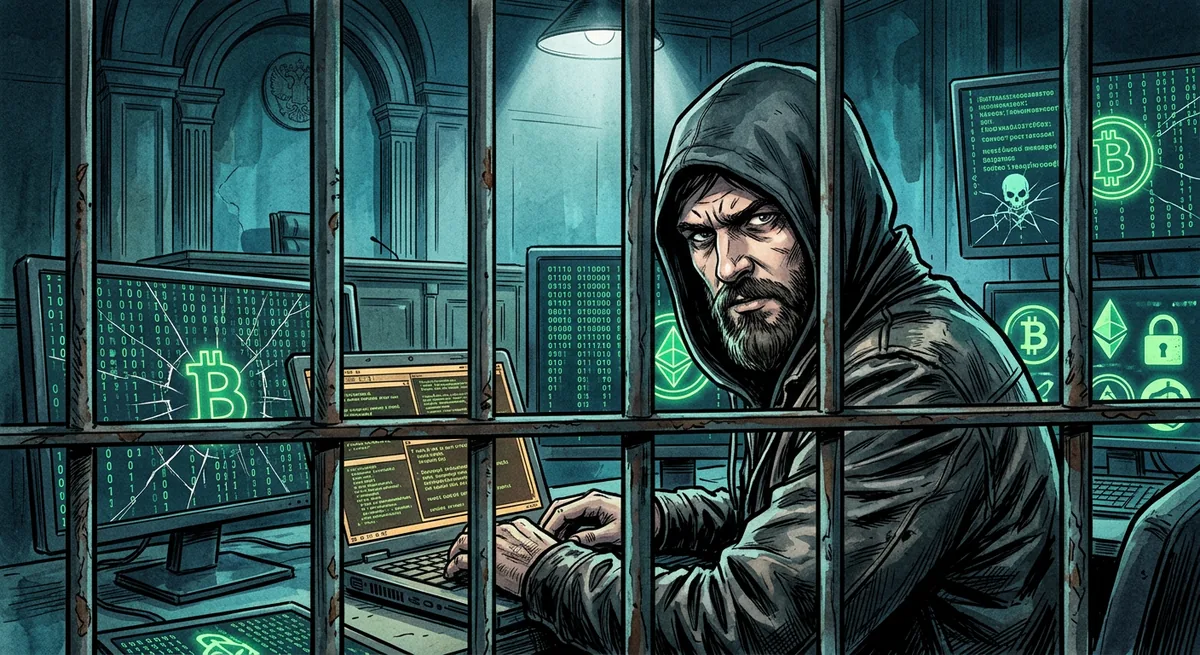
The most important person in a ransomware attack is often the one who never touches the ransomware. Aleksei Olegovich Volkov, a 26-year-old Russian citizen, has been sentenced to 81 months — nearly seven years — in US federal prison for his role as an initial access broker: the specialist who breaks into corporate networks and sells that foothold to the ransomware crews who do the encrypting and extorting.
Volkov fed his access to the Yanluowang ransomware group and other major operations, enabling dozens of attacks against US companies that caused over $9 million in actual losses and roughly $24 million in intended losses. Extradited from Italy after his January 2024 arrest, he pleaded guilty in November 2025 and has now been ordered to pay at least $9,167,198 in restitution to known victims and forfeit the tools of his trade.
The division of labor that powers modern ransomware
Volkov’s case is a clean illustration of how industrialized ransomware actually works. The popular image — a lone hacker who breaks in, encrypts everything, and collects the bitcoin — is years out of date. Today’s ecosystem is a supply chain with specialized roles, and the initial access broker (IAB) sits at the front of it.
The IAB’s job is singular: obtain unauthorized access to as many networks as possible — through phishing, stolen credentials, unpatched vulnerabilities, or info-stealer logs — and then sell that access on criminal forums to whoever wants it. The buyer, typically a ransomware affiliate, handles the rest: lateral movement, data theft, deployment, and negotiation. “Volkov’s co-conspirators then used the access Volkov provided to infect the affected computer networks and systems with malware,” as the Justice Department put it.
This specialization is exactly why the ransomware market has proven so resilient. We mapped the full structure in our analysis of the ransomware-as-a-service ecosystem after LockBit’s collapse, and the parallel market in criminal hosting that keeps it running in the bulletproof fortress. Brokers like Volkov are the connective tissue: remove one and the affiliates simply buy from another, which is precisely why his sentence matters more as deterrence than as disruption.
What he pleaded to
Volkov’s guilty plea covered a stack of charges that reads like an IAB job description: unlawful transfer of identification means, trafficking in access information, access device fraud, aggravated identity theft, and two counts of computer fraud, plus conspiracy to commit money laundering. The money-laundering count is the tell — brokering access isn’t only about breaking in, it’s about getting paid and cleaning the proceeds, the same downstream problem that drives so much of the enforcement pressure on the wider ransomware economy.
Italy, again, as the choke point
The extradition is worth noting on its own. Volkov was arrested in Italy in January 2024 and handed to US authorities — the same route that has delivered a string of high-value cybercriminals into American courtrooms. Europe’s willingness to detain and extradite Russian-nexus operators who travel west remains one of the few reliable levers against actors who would otherwise be untouchable inside Russia. It’s the same dynamic that brought a Conti ransomware figure from Ireland into US custody: the crime happens from a safe haven, but the moment the operator crosses a cooperative border, the warrants are waiting.
The strategy behind targeting brokers
Going after access brokers is a deliberate choice. Affiliates are numerous and interchangeable; the ransomware brands rebrand and reconstitute faster than they can be indicted. But the supply of capable brokers — people who can reliably compromise dozens of enterprise networks and monetize that access — is thinner. Pull them out of the market and you raise the price and lower the availability of the one input every ransomware attack requires: a way in.
Volkov won’t be the last broker to learn that lesson, and his removal won’t end the trade. But 81 months and a $9.16 million bill is a pointed message to the quiet specialists who think that never personally pulling the ransomware trigger keeps them safely in the background. In the eyes of US prosecutors, the doorman is just as liable as the burglars he let in.