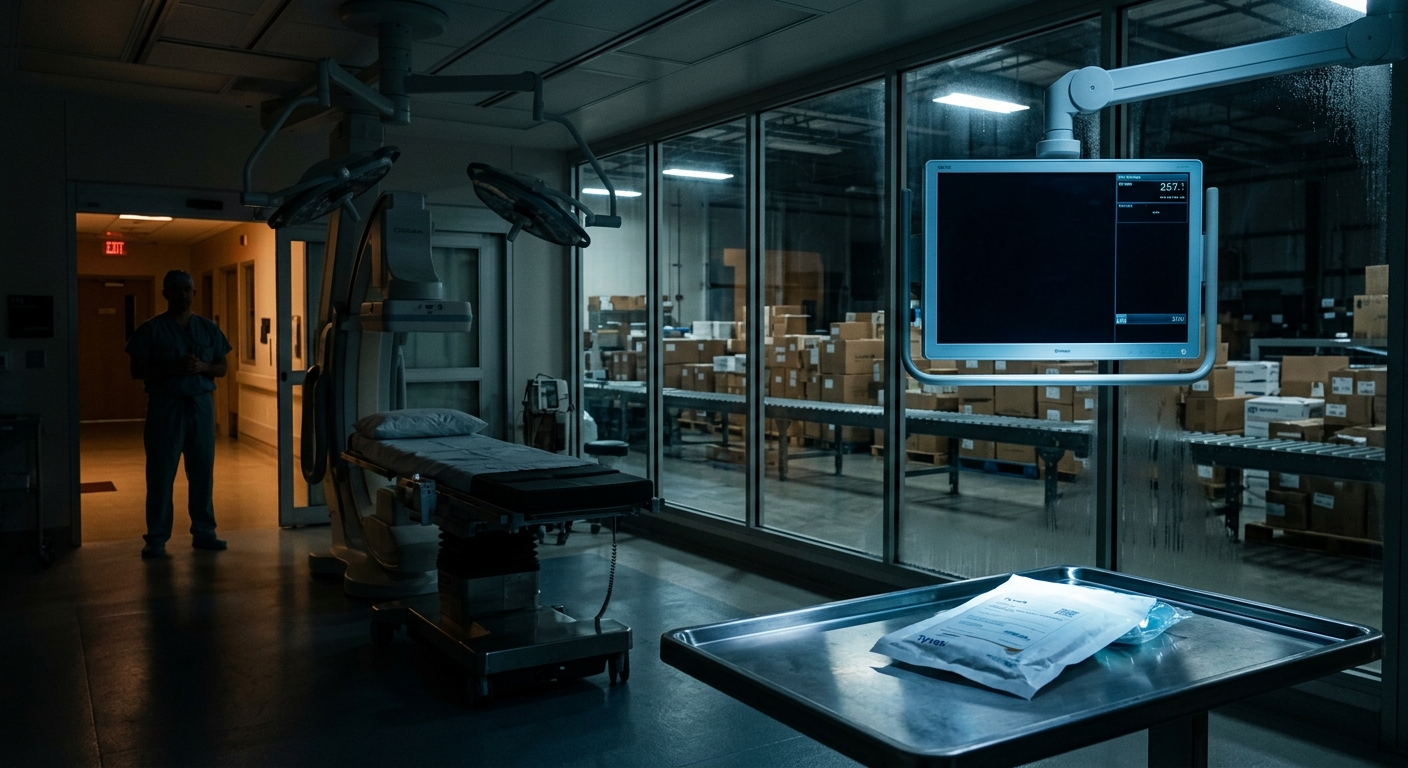
Boston Scientific detected a cybersecurity incident on August 25, 2026 that took technology systems offline across its global operations. The company confirmed the disruption has affected access to “certain operating systems and business applications, including the ability to process and ship customer orders.”
Boston Scientific manufactures pacemakers, cardiac stents, catheters and neuromodulation devices. An interruption to its shipping operation is not a back-office inconvenience. It is a supply problem for every hospital with a cardiac procedure on the schedule.
Shares fell on the disclosure. Analysts at Piper Sandler estimated it may be weeks before the company resumes normal operations, with a return to shipping all product lines possibly achievable in under three weeks. Boston Scientific itself has said the timeline for full restoration is not yet known.
A company spokesperson declined to say whether ransomware was involved.
Why a shipping outage becomes a clinical problem
The instinct is to file this alongside the manufacturing outages that have defined the past two years — Jaguar Land Rover, Asahi, the automotive supply chain. Those cost money and customer goodwill. This one has a different failure mode.
Implantable cardiac devices are not fungible inventory. A physician selects a specific device model for a specific patient based on lead configuration, battery chemistry, MRI compatibility, and the anatomy revealed in pre-procedure imaging. Hospitals do not warehouse deep stock of every variant; the economics of a device that costs five figures and has a shelf life do not support it. The model arrives for the case.
When the shipment does not arrive, the substitution options are narrow. A cardiac electrophysiologist cannot swap in a different manufacturer’s device on the morning of a procedure — the programmer, the leads and the follow-up ecosystem are all vendor-specific. The realistic outcomes are postponement or transfer.
For elective procedures, postponement is tolerable. For a patient admitted with symptomatic bradycardia awaiting a permanent pacemaker, or a patient staged for stenting after an acute coronary event, the schedule is not elastic. Every day of delay is a day the patient occupies a bed under monitoring, and the clinical risk is not zero.
The FDA restoration problem
There is a second constraint that makes the recovery timeline longer than an equivalent outage at a non-regulated manufacturer.
Boston Scientific’s order processing, lot tracking and distribution systems are part of an FDA-regulated quality system. Device traceability — knowing which serialized unit went to which facility for which patient — is a regulatory requirement, not a logistics preference. Recall capability depends on it entirely.
That means the company cannot simply restore from backup and resume shipping. It has to establish data integrity in the restored systems before product moves, because a distribution record that cannot be trusted is a traceability failure that would compromise any future recall. Validation of restored regulated systems is a documented, deliberate process, and it is why Piper Sandler’s “weeks” estimate is credible rather than pessimistic.
The ransomware question
Boston Scientific’s refusal to characterize the incident is standard practice during an active investigation and should not be read as confirmation either way. But the operational signature is worth noting: systems offline, business applications inaccessible, order processing and logistics specifically disrupted, restoration timeline unknown.
That profile is consistent with encryption of enterprise IT infrastructure — the ERP, warehouse management and order management layer — rather than with data theft alone. Data theft does not take systems offline.
The economics of the target are also unmistakable. An extortion operator evaluating leverage does not need to threaten Boston Scientific with data publication. Downtime alone is the leverage. A company that cannot ship revenue-generating product, whose customers are hospitals with scheduled surgeries, faces a pressure curve that intensifies every single day. As one analyst put it, attackers “don’t need to destroy anything. They just need to make downtime more expensive than whatever they’re asking for.”
No extortion group had claimed the incident as of publication.
The pattern this belongs to
August 2026 has produced an unusually concentrated run of healthcare-adjacent disruption. In the same window: the Nutex Health data exfiltration disclosed in an SEC filing on August 24; the Winnipeg Health Sciences Centre ransomware attack that reached door controls and HVAC; the CareCloud breach confirmed at 3.7 million patients.
What connects them is not a shared actor. It is that healthcare delivery now depends on a chain of IT-mediated dependencies — the practice management vendor, the billing platform, the building management system, the device manufacturer’s order system — where none of the links are hospitals and every one of them is a single point of failure for patient care.
Our H1 2026 healthcare breach review documented the sector’s exposure through the patient-data lens. Boston Scientific is the other lens: an incident with no patient records involved at all that nonetheless reaches directly into operating rooms.
What hospitals should do now
Facilities that source Boston Scientific product should not wait for the company’s restoration timeline:
- Inventory on hand by model, not by category, for cardiac rhythm management and interventional cardiology lines.
- Triage the procedure schedule for the next three weeks against that inventory and identify cases dependent on incoming shipments.
- Open lines with alternate manufacturers now. If substitution is clinically viable for a given case, the lead time on establishing a supply relationship is the constraint, and every hospital in the country is having this conversation simultaneously.
- Document the clinical decisions. Postponements driven by supply unavailability should be recorded as such.
- Treat vendor communications as a phishing surface. Attackers reliably impersonate disrupted vendors during high-profile outages, and hospital supply chain staff will be expecting unusual emails about Boston Scientific orders.
Sources
- Medical device firm Boston Scientific says cyberattack has disrupted shipment processes — The Record
- Medical device maker Boston Scientific is being hit by a cyberattack. The shares are falling — CNBC
- Cyberattack causes network outage at Boston Scientific, disrupts global operations — Help Net Security
- Boston Scientific cyberattack disrupts orders and shipping, restoration timeline unknown — Cybernews
- Medical Device Manufacturer Boston Scientific Faces Cyberattack — Security Magazine