DOJ's Epstein Files: When "Redacted" Doesn't Mean Redacted – A Cybersecurity Disaster

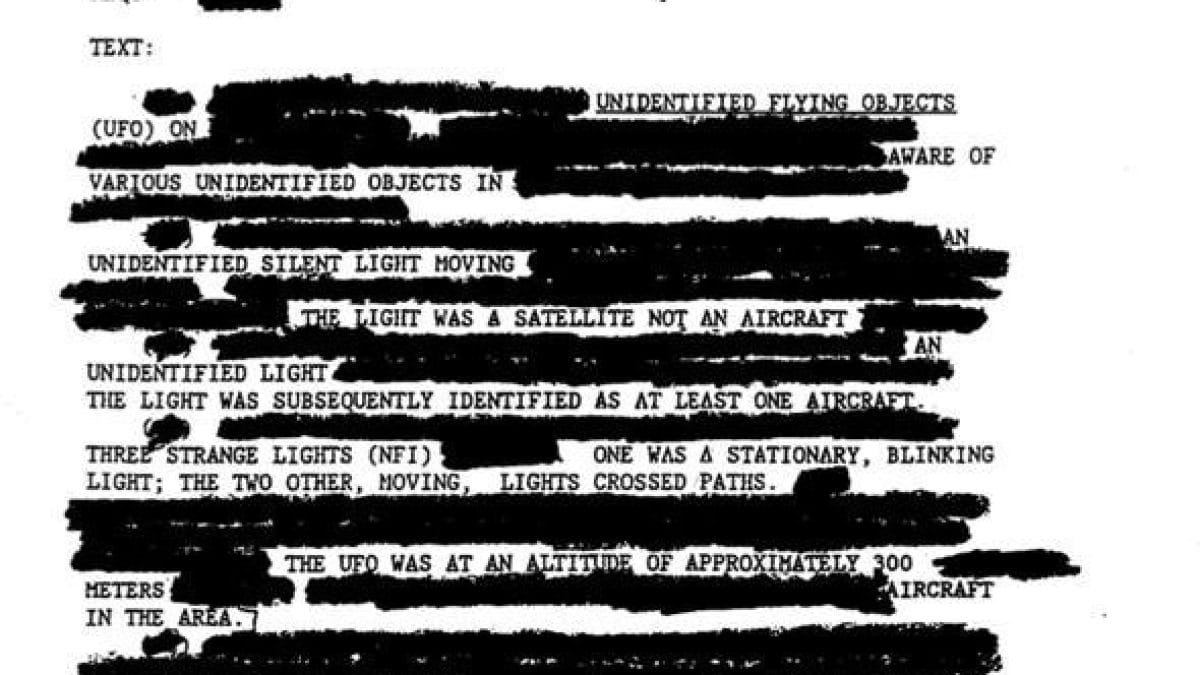
The Department of Justice just demonstrated what happens when document security meets government incompetence. In one of the most anticipated document releases in recent memory, the DOJ's December 19th dump of Jeffrey Epstein investigation files contained a security flaw so fundamental it belongs in a first-week InfoSec 101 curriculum: they "redacted" thousands of pages by simply placing black rectangles over text without removing the underlying data.
The result? Internet sleuths discovered within hours that supposedly classified information could be revealed with a simple copy-paste operation. No hacking required. No sophisticated forensics. Just highlight, Ctrl+C, Ctrl+V.
The Technical Failure: Redaction Theater
Proper PDF redaction requires permanently removing the underlying text objects from the document structure. Adobe Acrobat's dedicated redaction tool does this correctly. So does pdftk with the flatten operation. These tools don't just hide text—they obliterate it from the file's content stream entirely.
Instead, the DOJ appears to have used black box overlays that left the original text fully intact and searchable beneath the visual obstruction. This is the digital equivalent of using a marker on your computer screen and calling it encryption.
The Washington Examiner tested the flawed redactions and easily uncovered hidden information using nothing more than copy-paste into Google Docs or Microsoft Word. Social media users reported similar success across TikTok, Reddit, and Twitter, with posts demonstrating the technique garnering millions of views.
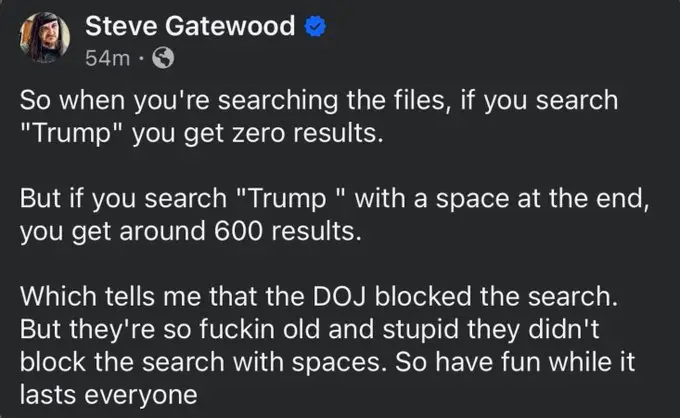
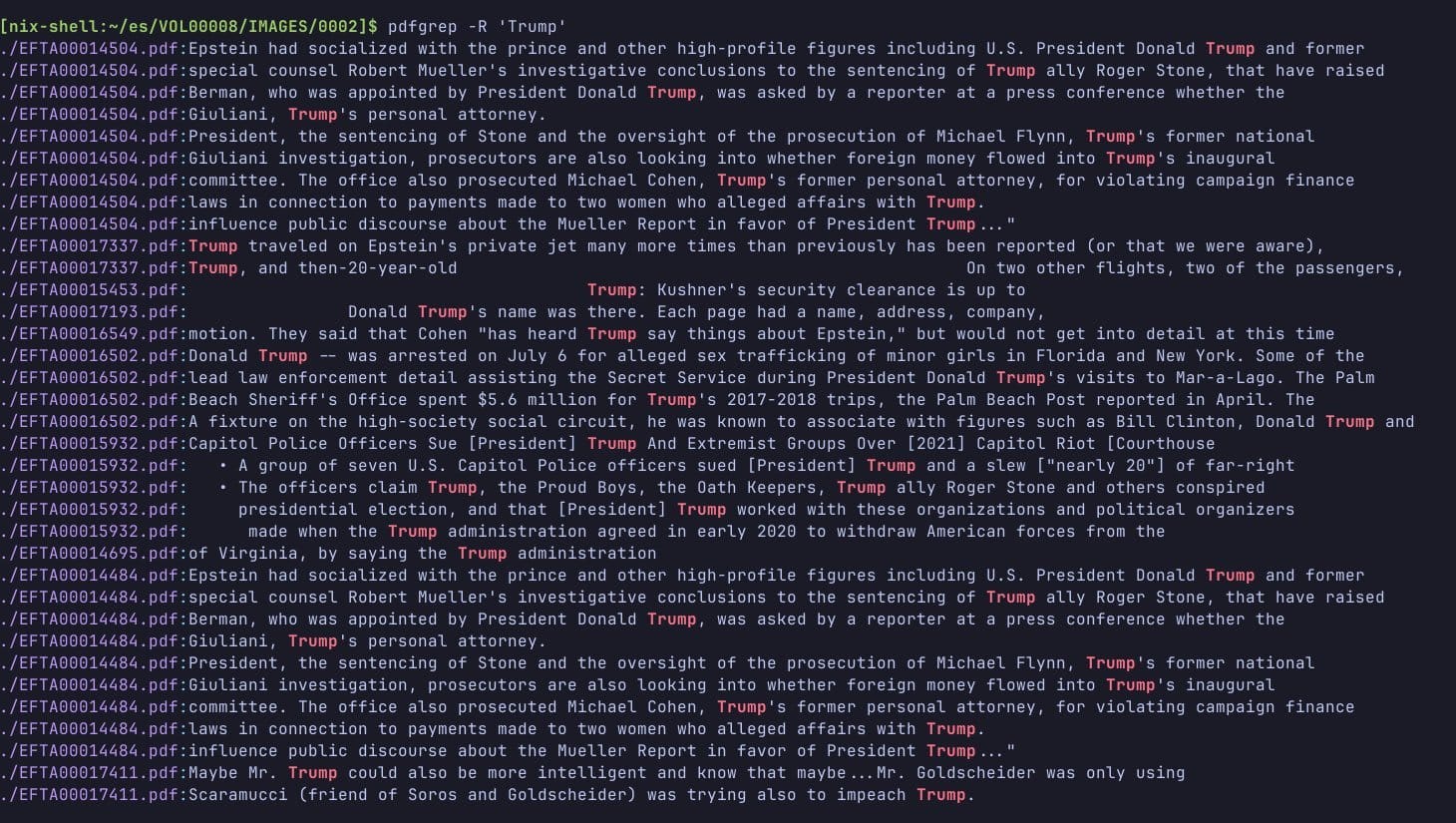
One particularly telling detail: searching the supposedly redacted documents for "Trump " (with a space) returns over 600 hits—exactly the kind of result you'd expect from text that was never actually removed.
What Was Hidden (And Quickly Revealed)
According to online investigators who accessed the improperly redacted sections, the exposed text included:
- Civil case details against Darren K. Indyke and Richard D. Kahn, executors of Epstein's estate, revealing payments exceeding $400,000 to young female models and actresses between September 2015 and June 2019
- Allegations of hush money schemes involving substantial payments to witnesses and victims to ensure compliance and silence
- Property tax discrepancies involving shell companies and unlisted homes
- Co-conspirator references from FBI emails citing "10 co-conspirators" being investigated in July 2019
The Guardian confirmed that one redacted passage detailed how "Between September 2015 and June 2019, Indyke signed for over $400,000 made payable to young female models and actresses, including a former Russian model who received over $380,000 through monthly payments of $8,333 made over a period of more than three and a half years until the middle of 2019."
The DOJ's Compounding Failures
The redaction disaster wasn't the only problem with the Epstein file release:
Violation of federal law: The Epstein Files Transparency Act required full release by December 19, 2025. The DOJ missed the deadline, releasing only a fraction of files with promises of "rolling releases" over subsequent weeks—a delay not authorized by law.
Excessive redactions: At least 550 pages in the initial release were entirely blacked out. One 119-page grand jury document was completely redacted. Three consecutive documents totaling 255 pages consisted of nothing but black boxes.
Disappearing documents: Within 24 hours of the initial release, at least 16 files vanished from the DOJ website without explanation, including one containing a photograph of President Trump. The files were later restored, but the unexplained removal fueled speculation about cover-ups.
Victim privacy violations: Multiple alleged Epstein victims discovered their names and identifying information had not been properly redacted, forcing attorneys representing over 200 survivors to spend the weekend working with federal officials to take down documents containing personal information. As Marina Lacerda, one of the survivors, publicly stated: "Who are we trying to protect? Are we protecting survivors or are we protecting these elite men that need to be put out there? And people need to know these are predators that are in the files. I feel like again the DOJ, the justice system is failing us."
Non-functional search: When the documents first appeared on the DOJ site, the search function designed to help navigate the files wasn't working for many users, defeating the law's requirement for "searchable and downloadable" files.
Selective Disclosure: Who's Being Protected?
The pattern of releases has raised questions about whether redactions are being applied strategically rather than legally. Angel Ureña, spokesman for former President Bill Clinton, issued a statement accusing the DOJ of selective transparency:
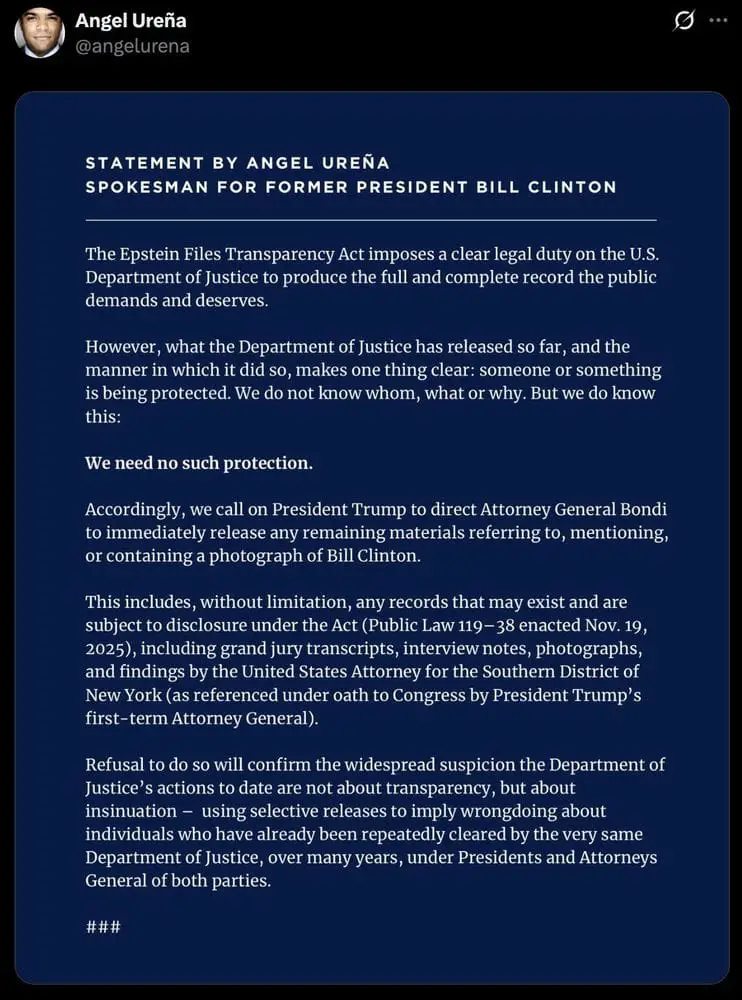
"However, what the Department of Justice has released so far, and the manner in which it did so, makes one thing clear: someone or something is being protected. We do not know whom, what or why. But we do know this: We need no such protection."
Ureña called on President Trump to "direct Attorney General Bondi to immediately release any remaining materials referring to, mentioning, or containing a photograph of Bill Clinton," including grand jury transcripts, interview notes, photographs, and findings from the Southern District of New York investigation.
The statement concluded with a sharp critique: "Refusal to do so will confirm the widespread suspicion the Department of Justice's actions to date are not about transparency, but about insinuation – using selective releases to imply wrongdoing about individuals who have already been repeatedly cleared by the very same Department of Justice, over many years, under Presidents and Attorneys General of both parties."
The Friday initial release included numerous photos of Clinton, including one in a hot tub with a redacted individual. Tuesday's release featured significantly more Trump material. The shifting focus has fueled speculation that political calculations, not legal requirements, are driving redaction decisions.
The survivors' statement also revealed systemic communication failures: "There has been no guidance for survivors on how to locate materials pertaining to our own cases, nor have we been provided with copies of our own files despite repeated requests. There has been no communication with survivors or our representatives as to what was withheld from release, or why hundreds of thousands of documents have not been disclosed by the deadline, or how DOJ will ensure that no more victim names are wrongly disclosed."
This lack of coordination directly contradicts Deputy Attorney General Todd Blanche's claims that the DOJ worked with victims' attorneys to compile a list of over 1,200 names requiring redaction. The survivors' statement makes clear: if such coordination occurred, it was inadequate and ineffective.
Bipartisan Outrage and Political Fallout
Representatives Ro Khanna (D-California) and Thomas Massie (R-Kentucky), who co-sponsored the Epstein Files Transparency Act, condemned the release as failing to comply with both "the spirit and the letter of the law."
Massie released a 14-minute video criticizing Attorney General Pam Bondi, Speaker Mike Johnson, and FBI Director Kash Patel for their handling of the release. Khanna stated he's exploring "all options," including impeachment referrals or prosecution for obstruction of justice. Senate Minority Leader Chuck Schumer introduced a resolution to "initiate legal actions" against the DOJ to demand compliance.
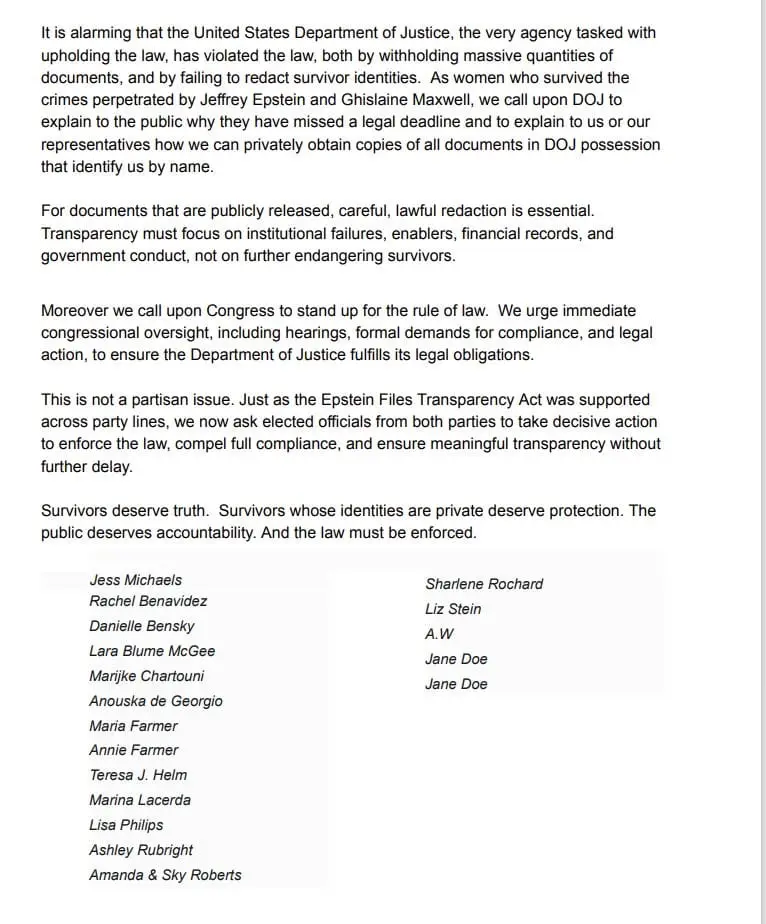
A group of alleged Epstein victims issued a scathing statement: "It is alarming that the United States Department of Justice, the very agency tasked with upholding the law, has violated the law, both by withholding massive quantities of documents, and by failing to redact survivor identities."
The statement, signed by prominent survivors including Maria Farmer, Annie Farmer, Marina Lacerda, and others (some using "Jane Doe" pseudonyms), detailed the comprehensive failures:
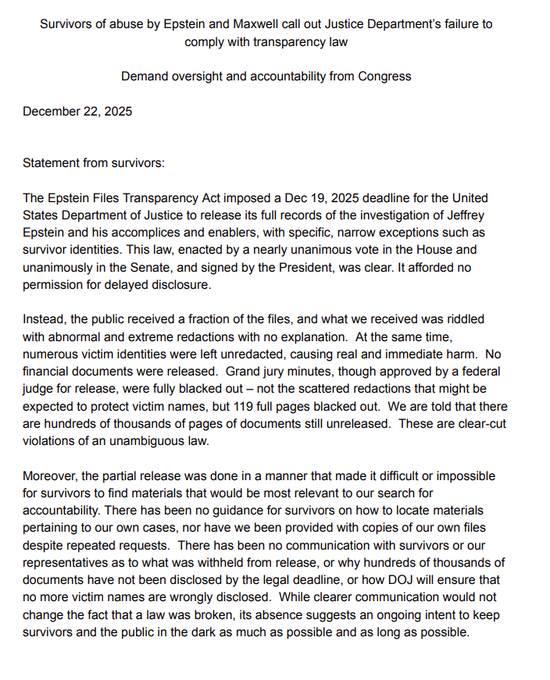
"Instead, the public received a fraction of the files, and what we received was riddled with abnormal and extreme redactions with no explanation. At the same time, numerous victim identities were left unredacted, causing real and immediate harm. No financial documents were released. Grand jury minutes, though approved by a federal judge for release, were fully blacked out – not the scattered redactions that might be expected to protect victim names, but 119 full pages blacked out."
The survivors emphasized a critical distinction often lost in the chaos: "For documents that are publicly released, careful, lawful redaction is essential. Transparency must focus on institutional failures, enablers, financial records, and government conduct, not on further endangering survivors."
They called on Congress to enforce the law immediately: "This is not a partisan issue. Just as the Epstein Files Transparency Act was supported across party lines, we now ask elected officials from both parties to take decisive action to enforce the law, compel full compliance, and ensure meaningful transparency without further delay."
The statement concluded with a powerful summary: "Survivors deserve truth. Survivors whose identities are private deserve protection. The public deserves accountability. And the law must be enforced."
The Coffeezilla Connection: Documents That Never Were
This isn't the first questionable handling of Epstein files by the DOJ. Earlier in 2025, the department claimed it found "no incriminating 'client list'" after Attorney General Pam Bondi had stated in February that such a list was "sitting on my desk right now to review." The reversal drew outrage from conservative figures who had championed file transparency.
Content creator Coffeezilla, known for investigating cryptocurrency scams and financial fraud, highlighted the absurdity of the situation in viral social media posts showing the redaction failures. The incident became emblematic of government incompetence meeting public demand for accountability.
Citizen Coders Step In Where Government Failed
This latest fiasco follows a pattern of citizens building tools to compensate for government inadequacy in making the Epstein files accessible. As we previously reported in "Citizen Coders Built a Dark Google Suite to Search the Epstein Files Because the Government Wouldn't", independent developers created sophisticated search tools and databases when official government resources proved insufficient.
Now, those same citizen investigators are doing what hundreds of DOJ lawyers apparently couldn't: actually testing whether redactions work before releasing documents to the public.
The Information Security Implications
From an InfoSec perspective, this failure represents multiple breakdowns:
- No testing protocol: Basic quality assurance would have caught this. A single person right-clicking a document would have revealed the flaw.
- Wrong tools or improper usage: Either the DOJ used tools that don't properly redact, or their staff didn't understand how to use professional redaction software correctly.
- No security review: Documents underwent extensive legal review by hundreds of DOJ attorneys, but apparently no one tested the actual technical implementation of the redactions.
- Process failure: The FBI's "Special Redaction Project" (internally called the "Epstein Transparency Project") consumed 4,737 overtime hours between January and July 2025, costing taxpayers over $851,000—yet produced fatally flawed output.
As one cybersecurity analysis noted, "This isn't a story about politics or intent. It's a story about how PDF redaction is widely misunderstood and how visual concealment is often mistaken for actual data removal."
Why This Matters Beyond Epstein
The Epstein file redaction failure exposes vulnerabilities that likely exist across government document handling:
- How many other "classified" documents have similar flaws?
- What sensitive information has been inadvertently exposed through improper redaction?
- Are other federal agencies making the same mistakes?
PDFs are not flat documents. They're structured containers made up of objects, layers, fonts, and streams. If the redaction process doesn't actively remove or rewrite those objects, the data survives. In an era where documents are processed by automated systems, indexed by search engines, and analyzed by AI tools, visual redaction isn't just insufficient—it's dangerously misleading.
The $851,000 Question
The FBI spent nearly a million dollars in overtime specifically on redacting Epstein files. The Department of Justice had attorneys processing up to 1,000+ documents per week. Counterintelligence specialists were pulled from other work to focus exclusively on this project.
And yet, the final product failed at the most fundamental level: actually removing the text they intended to hide.
The irony is brutal. In trying to protect certain information while complying with federal law, the DOJ created a situation where poorly implemented "security" became worse than no security at all. The failed redactions drew attention, sparked viral social media posts, and ensured maximum public scrutiny of exactly the information they sought to conceal.
What Should Have Happened
Proper document security isn't complicated, but it requires attention to detail:
- Use dedicated redaction tools like Adobe Acrobat's redaction feature, not drawing tools
- Flatten the PDF after redaction to ensure no underlying data remains
- Test the output by attempting to extract text programmatically
- Verify searchability by running grep or find commands on redacted terms
- Have a technical security reviewer examine documents before public release
The fact that none of this apparently happened suggests systemic problems in how the DOJ handles document security—problems that extend far beyond one high-profile case.
The Broader Context: Government Competence in Question
This redaction disaster comes amid broader questions about the DOJ's handling of the Epstein investigation:
- References to "10 co-conspirators" in FBI emails from 2019, with no indication of what happened to those investigations
- A December 2019 memo about "co-conspirator investigation" status that remains largely redacted
- Plea negotiations mentioned with "another Epstein co-conspirator" in November 2020 documents
- Only two people ever charged in connection with Epstein's crimes: Epstein himself (who died in custody) and Ghislaine Maxwell (serving 20 years)
The redaction failures compound existing frustrations about government transparency, fueling conspiracy theories and undermining public trust in the investigation's integrity.
🚨 “It turns out the US department for justice made that exact mistake”
— Concerned Citizen (@BGatesIsaPyscho) December 23, 2025
This is Brilliant - Multiple Reports of people being able to copy and paste, parts of the redacted Epstein files, because someone administratively screwed up.
Every single bit of the decipherable redacted… pic.twitter.com/C78VS8atcc
Lessons for Organizations
The Epstein files debacle offers critical lessons for any organization handling sensitive documents:
Visual concealment ≠ data removal: Just because you can't see text doesn't mean it's gone. Redaction must alter the document's internal structure, not just its appearance.
Test your processes: If you're redacting documents, verify that your redactions actually work by attempting to defeat them using basic techniques.
Use purpose-built tools: Don't improvise document security. Use tools specifically designed for the task, and train staff on proper usage.
Security is everyone's job: Legal review isn't enough. Technical security review must be part of the document release process.
Assume adversarial analysis: In a high-profile release, assume hostile parties will examine your documents with sophisticated tools. If basic copy-paste defeats your security, you've failed.
The Current State of Affairs
As of December 23, 2025, the DOJ has released multiple tranches of documents:
- Initial December 19th release: ~3,500 files (3GB of data)
- December 20th midnight release: Additional grand jury materials and flight logs
- December 23rd release: More than 30,000 additional files
The department continues to issue defensive statements, with Deputy Attorney General Todd Blanche claiming the only redactions being applied are "those required by law—full stop." Yet the evidence suggests otherwise, with improper redactions and victim privacy violations documented by multiple independent sources.
Attorney General Pam Bondi now faces calls for impeachment and contempt of Congress charges over the handling of the releases. The administration that promised unprecedented transparency on the Epstein files has instead delivered a masterclass in security incompetence.
Conclusion: When Transparency Meets Incompetence
The DOJ's Epstein file release represents a perfect storm of legal obligation, political pressure, and technical incompetence. Required by federal law to release documents, pressured by both parties to be transparent, and apparently lacking the basic InfoSec knowledge to do it properly, the department managed to create a fiasco that satisfied no one.
Hundreds of DOJ lawyers reviewed these documents. None of them right-clicked.
The FBI spent 4,737 overtime hours and $851,000 on redactions. The redactions didn't work.
Congress passed a law requiring full transparency. The DOJ violated it.
And in the end, it took internet sleuths with basic computer skills mere hours to demonstrate what every InfoSec professional already knew: hiding text behind black boxes isn't redaction—it's security theater.
For those interested in properly accessing and searching the Epstein files, we recommend checking out the citizen-built tools we covered in our previous article: "Citizen Coders Built a Dark Google Suite to Search the Epstein Files Because the Government Wouldn't". When the government fails at basic document security, sometimes the public has to step in and do it right.
The Epstein Files Transparency Act required release of all DOJ files related to the investigation by December 19, 2025. As of this writing, the department remains in violation of federal law, with thousands of documents still unreleased and many of those released containing redactions that either fail technically or exceed what the law permits. The saga continues.