Germany Accuses Russia of Air Traffic Control Attack as Aviation Cybersecurity Crisis Deepens

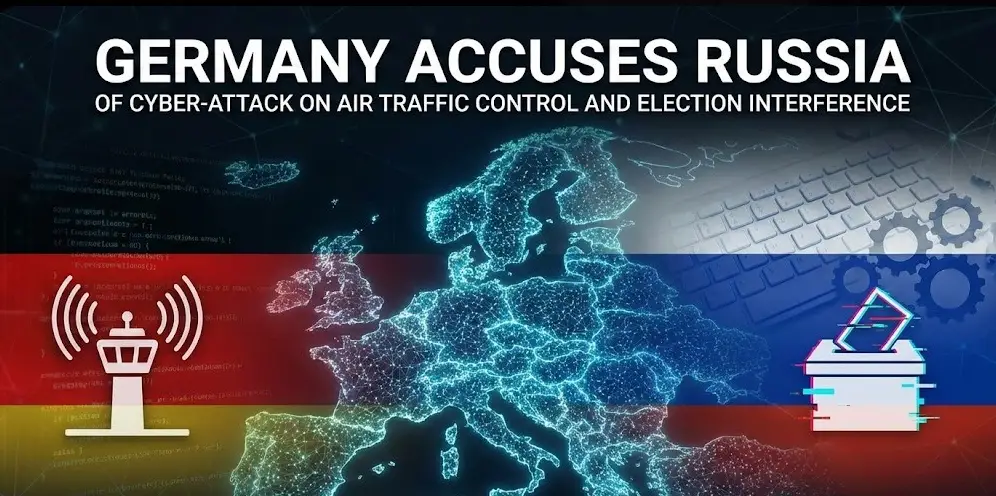
December 12, 2025 - In a stark escalation of cyber tensions, Germany has formally accused Russia's military intelligence agency of orchestrating a sophisticated cyber-attack against its air traffic control systems, joining a growing chorus of nations confronting an unprecedented wave of digital assaults targeting aviation infrastructure worldwide.
The German Foreign Ministry summoned Russia's ambassador to Berlin today, presenting what officials describe as "clear evidence" linking the August 2024 attack on Deutsche Flugsicherung—Germany's state-owned air traffic control operator—to APT28 (also known as Fancy Bear), a notorious hacking collective operating under Russia's Main Intelligence Directorate (GRU).
"Our intelligence findings prove that the Russian military intelligence service GRU bears responsibility for this attack," a Foreign Ministry spokesman declared, adding that Germany would coordinate with European partners to implement counter-measures designed to make Russia "pay a price for its hybrid actions."
The accusations extend beyond cyber-attacks to include electoral interference, with German officials alleging Russia attempted to destabilize the country's February 2025 federal election through a disinformation campaign designated "Storm 1516." Security agencies identified fabricated videos alleging ballot manipulation just days before the election, targeting prominent political figures including current Chancellor Friedrich Merz.
Russia has categorically denied the allegations. "The accusations of Russian state structures' involvement in these incidents and in the activities of hacker groups in general are baseless, unfounded and absurd," Russia's embassy in Berlin stated.
A Global Pattern: Aviation Infrastructure Under Systematic Attack
Germany's accusations represent just one theater in what security experts are describing as a coordinated global campaign against aviation infrastructure—a campaign that has intensified dramatically throughout 2024 and 2025 across multiple continents. As documented in our comprehensive analysis of the 2025 aviation cyberattack crisis, the sector has witnessed an unprecedented 131% surge in attacks between 2022 and 2023, with further acceleration through 2025.
 Breached Company
India's GPS Spoofing Crisis: Over 800 Flights Disrupted
The most dramatic aviation security incident of 2025 unfolded over India's skies, where sophisticated GPS spoofing attacks have created what experts call an "invisible danger" to civil aviation. On November 7, 2025, Air India flight AI302 was forced to abort its landing approach at New Delhi's Indira Gandhi International Airport when its GPS readings suddenly placed the aircraft miles from its actual position near Runway 10.
The incident triggered cascading disruptions across India's aviation network—over 800 flights experienced delays or diversions that day alone. Within 48 hours, India's Directorate General of Civil Aviation issued emergency procedures mandating real-time reporting of any GPS anomalies within 10 minutes of detection.
India's Civil Aviation Minister Ram Mohan Naidu formally confirmed to Parliament that GPS spoofing and jamming has affected eight major airports since 2023, with "regular" incidents reported at Delhi, Kolkata, Amritsar, Mumbai, Hyderabad, Bangalore, and Chennai airports.
The Scale of the Threat:
- Over 465 spoofing cases reported near Amritsar and Jammu alone since November 2023
- Delhi Flight Information Region has experienced daily spoofing since May 2024
- More than 10% of flights affected in high-risk corridors
- Over 100 incidents in Delhi during a two-month period
"GPS spoofing is not only a technical anomaly but could be a powerful tool of asymmetric or electronic warfare, capable of misleading aircraft, disrupting airspace surveillance, and endangering civilian lives," warned analysts at the Observer Research Foundation.
Military Aircraft Targeted During Humanitarian Operations
The threat extends beyond civilian aviation. During "Operation Brahma"—India's humanitarian relief mission to earthquake-stricken Myanmar in March 2025—Indian Air Force C-130J Hercules and C-17 Globemaster transport aircraft reported GPS spoofing while in Myanmar's airspace. Pilots were forced to rely on backup internal navigation systems to ensure safe navigation, raising serious questions about the militarization of GPS interference.
Similarly, in August 2025, an aircraft carrying European Commission President Ursula von der Leyen was forced to resort to manual navigation following GPS jamming. The EU directly blamed Russia for that incident.
Europe's Airport Ransomware Catastrophe
While GPS spoofing threatened aircraft in the skies, a devastating ransomware attack struck Europe's ground infrastructure in September 2025, exposing critical vulnerabilities in the aviation ecosystem's supply chain. As detailed in our breaking coverage of the Collins Aerospace cyber-attack, this incident brought Europe's busiest airports to their knees.
On Friday, September 19, 2025, hackers launched a coordinated cyber-attack against Collins Aerospace, a major U.S.-based aviation technology provider whose MUSE software powers check-in and boarding systems at approximately 170 airports globally. The attack crippled operations at some of Europe's busiest hubs:
Impact Assessment:
- London Heathrow (Europe's busiest airport: 7.9 million monthly passengers)
- Berlin Brandenburg Airport (25.5 million annual passengers)
- Brussels Airport (requested airlines cancel 50% of Monday flights)
- Dublin and Cork airports in Ireland
- Dozens of flight cancellations, hundreds delayed
- Passengers waited up to 8 hours as airlines resorted to handwritten boarding passes
The European Union Agency for Cybersecurity (ENISA) confirmed the attack as ransomware, though the perpetrators' identity remains officially unconfirmed. A man in his forties was arrested in West Sussex, England, on September 24 in connection with the attack, though investigations remain ongoing. Our initial reporting on the major European airport disruptions and ongoing coverage documented the cascading impact across the continent.
"The aviation sector saw a 600% increase in cyberattacks from 2024 to 2025," according to a report by French aerospace company Thales, highlighting the industry's rapidly escalating vulnerability. The attack also resulted in a significant data breach at Dublin Airport, exposing 3.8 million passengers when Collins Aerospace's compromised systems leaked passenger booking data.
The Strategic Dimensions of Aviation Cyber Warfare
Why Aviation? The Perfect Target for Hybrid Warfare
Aviation infrastructure presents an exceptionally attractive target for state and non-state actors engaging in hybrid warfare:
- Critical Dependency: Modern aviation relies almost entirely on GPS/GNSS for navigation, approach procedures, and timing synchronization. This creates a single point of failure that can be exploited.
- Psychological Impact: Disrupting air travel creates immediate public awareness and anxiety, amplifying the attack's political effects beyond its technical scope.
- Economic Leverage: Each disrupted flight cascades into massive economic costs—delayed cargo, missed connections, hotel accommodations, and lost productivity.
- Cascading Vulnerabilities: The aviation ecosystem's interconnectedness means a single compromised vendor (like Collins Aerospace) can paralyze dozens of airports simultaneously.
The Technology Behind GPS Spoofing
GPS spoofing represents a particularly insidious threat because it operates invisibly. Unlike jamming, which blocks signals and triggers immediate alerts, spoofing broadcasts false satellite signals that mimic legitimate ones—but are slightly stronger. Aircraft receivers lock onto these counterfeit signals, calculating incorrect positions while displaying no obvious error indicators.
"Clock bias, multiple signals and higher carrier noise are indicators of spoofing," explained Tom Kellermann, vice president of cyber risk at a major health information technology firm. "Current evidence shows Indian systems lack widespread deployment of detection tools, creating a gap in anomaly verification."
The mechanics are deceptively simple: commercially available software-defined radios (SDRs) and GPS signal simulators can be assembled for relatively low cost, miniaturized, battery-operated, and even drone-mounted. This allows hostile actors to position spoofers near airports, borders, or sensitive installations with minimal infrastructure.
Known Threat Actors and Their Capabilities
APT28 / Fancy Bear (Russia - GRU Unit 26165): Operating since at least 2008, this sophisticated threat group has demonstrated extensive capabilities and persistent targeting of Western infrastructure. As documented in our comprehensive analysis of France's accusations against APT28, the group has conducted systematic campaigns against European allies.
The group achieved a significant milestone in November 2025 when GRU officer Alexey Lukashev was arrested in Thailand—the first-ever arrest of a Fancy Bear member despite the group operating for over 16 years.
APT28 has demonstrated:
- Zero-day exploit development
- Multi-platform malware capabilities (Windows, Linux, macOS, mobile)
- Advanced phishing and credential harvesting
- Sustained concurrent operations across multiple targets
- Recent "Nearest Neighbor" Wi-Fi attack methodology
Previous High-Profile Campaigns:
- 2016 U.S. Democratic National Committee breach
- 2024 Ukrainian defense contractor espionage campaign
- 2025 targeting of European logistics supporting Ukraine
- French election interference attempts (2017, 2025)
- German Bundestag intrusion
- World Anti-Doping Agency data theft
India's Unique Challenge: Border Tensions and Electronic Warfare
India faces a particularly complex threat landscape. Intelligence assessments suggest GPS spoofing incidents correlate geographically and temporally with heightened drone activity along the India-Pakistan and India-Myanmar borders.
The Border Security Force (BSF) has intercepted nearly 300 Pakistani drones carrying narcotics, counterfeit currency, and weapons—many operating during periods of GPS interference. This suggests coordinated electronic warfare designed to:
- Create confusion in controlled airspace (tactical disruption)
- Mask drone movements with electromagnetic interference (operational masking)
- Signal capability and intent to adversaries (strategic signaling)
According to the OPS Group aviation safety organization, the Delhi Flight Information Region ranks ninth globally among areas most affected by spoofing, with 316 aircraft impacted between July 15 and August 15, 2024 alone.
The Response: Detection, Mitigation, and Resilience
India's Multi-Layered Response Strategy
Following the November 2025 crisis, Indian authorities have implemented comprehensive countermeasures:
Immediate Actions:
- Mandatory 10-minute reporting protocols for GPS anomalies
- Advisory Circular ANSS AC 01 (2023) addressing GNSS interference
- Standard Operating Procedures for contingency navigation
- Wireless Monitoring Organization tasked with source identification
- Ministry of Home Affairs coordination on national security implications
Long-term Modernization: Cybersecurity experts are calling for a fundamental shift in India's aviation infrastructure:
- Multi-Sensor Positioning: Integration of NavIC (India's indigenous satellite navigation system) alongside GPS, encrypted signals, anti-jam antennas, and chip-scale atomic clocks
- Legacy System Redundancy: Maintaining and upgrading Instrument Landing Systems (ILS) and ground-based navigation aids as fallbacks
- Real-Time Detection: AI-driven platforms capable of identifying spoofing signatures through anomaly detection
- Spectrum Monitoring: Continuous radio frequency surveillance around airports and flight corridors
- Air Traffic Controller Staffing: Addressing chronic ATCO shortages that create dangerous workload conditions during GPS failures
Europe's Supply Chain Security Wake-Up Call
The Collins Aerospace ransomware attack exposed critical vulnerabilities in aviation's supply chain model. As we explored in our analysis When the Skies Go Dark: The European Airport Cyberattack and the Fall of Scattered Spider, this architectural weakness creates what cybersecurity experts call "single points of failure" where one successful attack can cascade across multiple airports and airlines, affecting thousands of flights and millions of passengers.
The World Economic Forum's Centre for Cybersecurity has outlined essential collaborative measures:
Shared Responsibility Framework:
- Establish security baselines for critical vendors based on shared expertise
- Develop joint incident response playbooks
- Conduct collaborative red-team exercises
- Implement secure-by-design requirements across the supply chain
- Improve information-sharing between technology providers, airlines, and governments
"The recent cyberattack on airport check-in and boarding systems across Europe is a stark reminder that cyber resilience is a shared responsibility across the entire aviation ecosystem—including airlines, service providers, technology partners and regulators," said Akshay Joshi, head of the World Economic Forum's Centre for Cybersecurity.
Germany's Coordinated European Response
Germany has announced it will implement counter-measures in close coordination with European partners, including support for new EU sanctions targeting actors involved in hybrid warfare operations. This represents a shift toward collective cybersecurity defense rather than isolated national responses.
The Broader Implications for Critical Infrastructure
The convergence of these attacks—air traffic control systems in Germany, GPS spoofing across India, and supply chain ransomware in Europe—reveals a troubling pattern: critical infrastructure has become the primary battlefield for 21st-century geopolitical competition.
The aviation sector's 2025 crisis extends beyond these headline incidents. As documented in our Aviation Under Siege report, major carriers have fallen victim to sophisticated operations:
- Aeroflot: Pro-Ukrainian hackers devastated Russia's flagship airline in a year-long operation, destroying 7,000 servers and extracting 12TB of databases
- WestJet: Canada's major carrier faced a sophisticated cyberattack affecting mobile applications and internal systems
- American Airlines (Envoy Air): Hit by Clop ransomware exploiting Oracle zero-day vulnerabilities
- Qantas Airways: Compromised in a third-party Salesforce breach affecting 5.7 million customer records
The Hybrid Warfare Playbook
State actors are employing cyber operations as a component of broader hybrid strategies that combine:
- Electronic warfare (GPS/GNSS disruption)
- Cyber intrusions (ransomware, data theft)
- Information operations (disinformation campaigns like Storm 1516)
- Physical threats (drone incursions)
- Economic pressure (supply chain targeting)
This integrated approach allows adversaries to operate below the threshold of conventional military conflict while achieving strategic effects.
Aviation as a Proving Ground
"This GPS spoofing event is part of a broader, escalating trend globally in cyber-physical attacks targeting critical infrastructure," warned Apeksha Kaushik, principal analyst at Gartner. "The weaponization of spectrum and proliferation of low-cost electronic warfare tools" means GNSS jamming and spoofing have moved from rare anomalies to "expected failure scenarios" that aviation must be prepared to withstand.
The aviation sector's experiences offer critical lessons for other infrastructure domains:
- Over-Reliance on Single Technologies Creates Catastrophic Risk: GPS dependency mirrors similar vulnerabilities in power grids (SCADA systems), financial networks (SWIFT), and telecommunications (DNS).
- Supply Chain Complexity Multiplies Attack Surface: The Collins Aerospace incident demonstrates how a single vendor compromise can cascade across dozens of dependent organizations.
- Legacy Systems Matter: India's ability to revert to conventional navigation aids prevented catastrophic outcomes—a reminder that modernization shouldn't eliminate redundant backup systems.
- Attribution Remains Challenging: While Germany presented "clear evidence" of Russian involvement, many attacks remain officially unattributed, complicating diplomatic and legal responses.
Looking Forward: An Industry at an Inflection Point
The aviation industry stands at a critical juncture. The traditional approach—reactive patching and incident response—proves inadequate against adversaries conducting systematic reconnaissance and developing sophisticated multi-vector attack campaigns.
Required Strategic Shifts
1. Assume Compromise: Aviation organizations must operate under the assumption that sophisticated adversaries already have footholds in their networks and plan accordingly.
2. Exposure Management: Move from perimeter defense to comprehensive visibility across all attack surfaces—IT networks, operational technology, vendor access points, and electromagnetic spectrum.
3. Resilience Over Prevention: Accept that some attacks will succeed; design systems to maintain essential functions during and after compromise.
4. Intelligence-Driven Defense: Leverage threat intelligence sharing across borders and sectors to identify patterns before attacks materialize.
5. International Coordination: Establish rapid-response protocols allowing affected nations to warn others immediately when attacks are detected.
The Geopolitical Context
These aviation cyber incidents unfold against a backdrop of deteriorating relations between Russia and Western nations following Moscow's 2022 invasion of Ukraine. Germany has emerged as one of Ukraine's strongest supporters, providing extensive military, financial, and diplomatic assistance—creating clear motives for Russian hybrid warfare targeting German critical infrastructure.
Similarly, India's GPS spoofing incidents correlate with heightened tensions along disputed borders, where electronic warfare capabilities serve both tactical military purposes and broader strategic signaling.
"Cyberattacks rarely stop at national borders, so the faster one country can identify and report an attack, the faster others can take action to contain it," noted cybersecurity expert in response to the European airport ransomware.
Conclusion: The New Normal
Aviation has entered an era where cyber and electronic warfare capabilities represent constant threats to flight safety and operational continuity. The convergence of state-sponsored campaigns (Germany's air traffic control, India's GPS spoofing) with criminal ransomware operations (European airports) demonstrates that threats come from multiple directions simultaneously.
The stakes extend far beyond inconvenienced travelers or delayed flights. At their core, these attacks target the trust, reliability, and safety that underpin modern aviation—and by extension, global economic connectivity and national security.
As APT28 and similar threat actors continue evolving their tactics, the aviation industry must fundamentally transform its approach to cybersecurity. The question is no longer whether attacks will occur, but whether the sector can build sufficient resilience to maintain safe operations despite them.
Germany's decision to formally attribute and publicly confront Russian cyber operations represents one possible path forward: transparency, attribution, coordinated international response, and concrete consequences for hybrid warfare. Whether this approach proves effective may determine not just the future of aviation security, but the viability of critical infrastructure in an age of persistent digital conflict.
Key Takeaways
For Aviation Professionals:
- Implement multi-layered positioning systems immediately (GPS + NavIC/Galileo + terrestrial backups)
- Conduct regular red-team exercises simulating GPS loss scenarios
- Establish 10-minute reporting protocols for any navigation anomalies
- Review supply chain vendor security requirements and contingency plans
For Policymakers:
- Develop rapid attribution and response frameworks for infrastructure attacks
- Invest in domestic satellite navigation capabilities to reduce GPS dependency
- Establish international norms and consequences for attacks on civilian aviation
- Address critical staffing shortages in air traffic control
For Security Teams:
- Deploy AI-driven anomaly detection focused on spectrum-based attacks
- Implement comprehensive exposure management across IT and OT environments
- Establish secure communication channels with peer organizations for threat intelligence sharing
- Maintain and test legacy backup systems—they may save lives
The aviation cyber warfare campaign of 2024-2025 has made one thing clear: the skies are no longer safe from digital threats. Only through sustained investment in resilience, international cooperation, and fundamental security transformation can the industry hope to navigate the turbulent air ahead.
This analysis synthesizes information from official government statements, cybersecurity research organizations, aviation safety groups, and international intelligence assessments regarding aviation infrastructure cyber threats during 2024-2025.
Related Coverage on Breached Company
European Airport Attacks:
- Major Cyber-Attack Disrupts European Airport Operations
- Breaking Down the Collins Aerospace Cyber-Attack
- After-Weekend Update: Ransomware Attack Continues
- When the Skies Go Dark: The European Airport Cyberattack
- Dublin Airport Data Breach Exposes 3.8 Million Passengers
Aviation Industry Crisis:
- Aviation Under Siege: The 2025 Airline and Airport Cyberattack Crisis
- Aeroflot Under Siege: Pro-Ukrainian Hackers Devastate Russian Airline
- WestJet Under Siege: Canada's Critical Aviation Infrastructure Targeted
- American Airlines Subsidiary Hit by Clop Ransomware
APT28/Fancy Bear Operations:
- France vs. Russia: Unmasking APT28's Cyber Espionage Campaign
- Russian GRU Officer Alexey Lukashev Arrested in Thailand
- Russia-Linked Cyberattack Exposes Critical Vulnerabilities in Federal Court Systems
State-Sponsored Cyber Warfare: