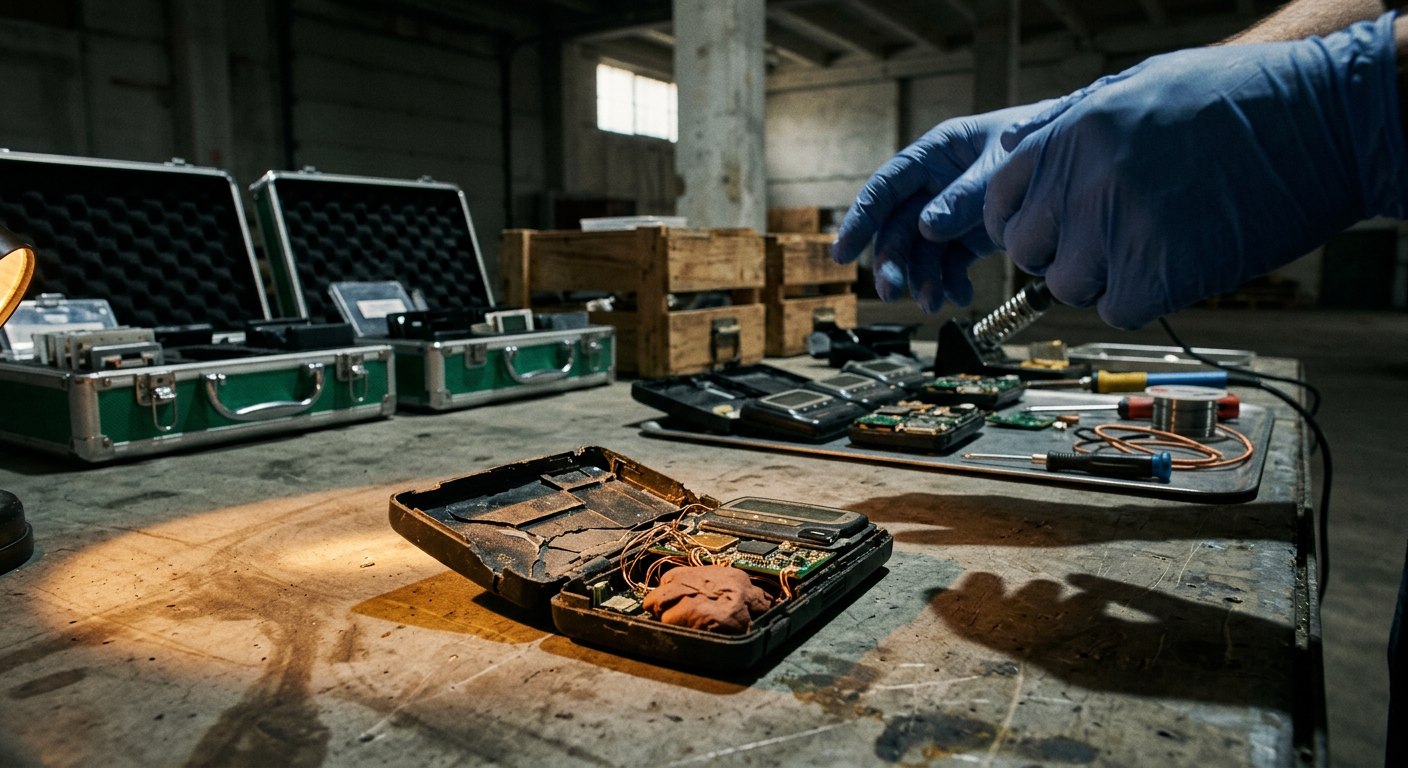
It is the attack the entire security industry quietly reorganized its threat models around, and most people outside the field still don’t understand how it actually worked. On the afternoon of September 17, 2024, at roughly 3:30 p.m. local time, thousands of pagers carried by Hezbollah members began to vibrate, display an incoming message, and then — seconds later, as their owners brought the devices up to read them — explode. A day later, on September 18, the group’s walkie-talkies did the same. By the time the dust settled, at least 42 people were dead, including a reported 12 civilians and several children, and between 3,500 and 4,000 were wounded, many maimed in the hands, face, and eyes.
This was not a hack in the conventional sense. No one popped a server or phished a credential. Israel’s Mossad, in a joint operation with the Israeli military reportedly nicknamed “Operation Grim Beeper,” had spent years turning Hezbollah’s own communications supply chain into a distributed weapons system — and then detonated it on command. Nearly two years on, it remains the most consequential hardware supply-chain attack ever executed, and the clearest real-world proof that the device in your pocket is only as trustworthy as the most compromised link in the chain that built it.
The setup: Hezbollah’s own paranoia became the attack surface
The grim irony is that the victims were trying to be careful. Hezbollah leader Hassan Nasrallah had, months earlier, warned his fighters to stop carrying smartphones, correctly assessing that Israel could geolocate and surveil them through cellular networks — exactly the kind of mobile-implant tradecraft we’ve documented across the commercial spyware ecosystem. So the organization went low-tech on purpose, ordering a large batch of simple pagers as a “secure,” un-trackable alternative.
Israel anticipated the move. Rather than try to break into the new devices after the fact, Mossad arranged to be the supplier.
The supply chain: shell companies all the way down
The pagers were branded Gold Apollo AR-924, a model from the Taiwanese firm Gold Apollo. But Gold Apollo didn’t make the lethal batch. It had licensed its brand to a Budapest-based company called BAC Consulting Kft. — and according to subsequent reporting in the New York Times, BAC Consulting and at least two other shell corporations were Mossad fronts, created specifically to manufacture, market, and sell booby-trapped hardware while obscuring any connection to Israeli intelligence.
This is the part security teams should sit with. Israel didn’t intercept a shipment and tamper with it in a warehouse. It built a legitimate-looking commercial entity with real clients and a real product line, established the bona fides over time, and then steered the compromised devices to its target as a trusted vendor. The booby-trapped walkie-talkies — counterfeit Icom IC-V82 units — flowed through the same playbook, entering Hezbollah’s emergency communications system as ordinary procurement.
Inside each device sat roughly three grams of PETN, a high explosive, integrated alongside the battery in a configuration designed to be invisible to X-ray and airport screening. A remote trigger was embedded so the entire fleet could be detonated simultaneously by a signal delivered as an innocuous-looking page. When the message arrived, the device buzzed — drawing the owner’s hand and face toward it — and then fired.
Two waves, ten days, and a war
The tactical effect was staggering. A Hezbollah official later conceded that around 1,500 fighters were incapacitated by their injuries in a matter of seconds — a degradation of fighting strength no airstrike could have achieved so surgically. The psychological effect was larger still: overnight, every electronic object in the organization became suspect. Radios, phones, chargers, batteries — anything could be the next bomb. That is the real payload of a supply-chain attack: not just the blast, but the collapse of trust in your own equipment.
The operation cracked Hezbollah’s command structure open at exactly the moment Israel needed it. Just ten days later, Israeli forces located and killed Nasrallah in a strike on the group’s Beirut headquarters, and on October 1, 2024, Israel launched its ground invasion of southern Lebanon. The pager attack is best understood not as a standalone stunt but as the opening move of the wider war — the same regional conflict whose digital dimensions we’ve tracked in The Cyber War in the Shadows and the cyber proxy war between Israel and Iran.
Prime Minister Benjamin Netanyahu publicly confirmed Israeli responsibility in November 2024, framing the operation as one carried out “despite the opposition of senior officials.”
The legal and ethical fault line
The attack split international law experts sharply. UN special rapporteurs and human-rights bodies warned it may constitute a war crime, on two grounds: the principle of distinction (the devices detonated indiscriminately, wherever their carriers happened to be — grocery stores, homes, streets, beside children) and the prohibition on booby-traps under the Convention on Certain Conventional Weapons, which bars rigging ordinary-looking everyday objects to explode. Belgian officials went further and labeled it a “terror attack.” Israel and its defenders countered that the devices were issued to a designated terrorist organization’s operatives and that the targeting was, in fact, more discriminate than conventional bombing.
We’re not going to resolve that debate here. What’s undeniable is that a threshold was crossed: a state demonstrated, at scale and in public, that it could weaponize the global electronics supply chain against human beings, and that the line between “compromised device” and “lethal device” is thinner than anyone wanted to believe.
What this means for everyone else
The obvious objection is “I’m not Hezbollah — no one is putting PETN in my laptop.” True. But strip the explosives away and the structure of the attack is something every CISO already loses sleep over: a trusted vendor, established over years, delivering a compromised product through legitimate procurement channels. Swap PETN for a hardware implant, a malicious firmware backdoor, or a poisoned dependency, and Operation Grim Beeper is just the most violent expression of the same supply-chain risk that drives modern security programs. The lesson isn’t “screen your pagers for explosives.” It’s that provenance is a security control — that who built a thing, and who touched it before it reached you, is part of your attack surface whether you account for it or not.
There’s a personal-security dimension too, and it’s where this story stops being abstract. The Hezbollah members who died weren’t killed because they were careless with passwords; they were killed because they were identifiable, reachable, and predictable as a group — they all carried the same issued device, sourced from the same channel, at the same time. The defensive instinct that runs counter to that is the subject of the Gray Man Theory — the discipline of not standing out, not being trackable as part of a targetable set, and concealing your preparedness by blending in. Operation Grim Beeper is, among other things, the most extreme case study in what happens when an entire population fails the gray-man test: uniform devices, uniform behavior, a single point of supply, and an adversary patient enough to own all three.
The new baseline
Two years later, the attack’s longest shadow falls on hardware trust. It is now an explicit, demonstrated fact — not a thought experiment — that a sufficiently capable state can establish a front company, sell you authentic-looking hardware, and retain a remote capability inside it. That reality is already reshaping how governments and defense contractors think about procurement, and it sits directly underneath the broader collapse of allied trust we’re watching play out in real time, like the U.S. Defense Intelligence Agency’s recent decision to rate Israel a “critical” counterintelligence threat after spyware turned up on American officials’ phones.
The pagers stopped exploding in September 2024. The question they detonated — can you trust the device in your hand? — never stopped.
Sources
- Israel behind deadly pager explosions that targeted Hezbollah — CNN
- What we know as death toll from pager explosion attack rises — PBS NewsHour
- 2024 Lebanon electronic device attacks — Wikipedia
- Walkie-talkies explode in Lebanon day after deadly pager attack — CNN
- Hezbollah walkie-talkies exploded too: what to know about Israel’s attacks — Al Jazeera
- “Well, it Depends”: The Explosive Pagers Attack Revisited — Lieber Institute, West Point
- The exploding device attacks dealt a major but not crippling blow to Hezbollah — The Washington Post
Further reading
- The Gray Man Theory: Personal Protection by Blending In — secureiot.house
- Spyware on the Negotiators’ Phones: The DIA Rates Israel a ‘Critical’ Counterintelligence Threat
- The Cyber War in the Shadows: The 2026 Iran–Israel–U.S. Conflict
- The Cyber Arms Trade: How Commercial Spyware Is Reshaping Global Security