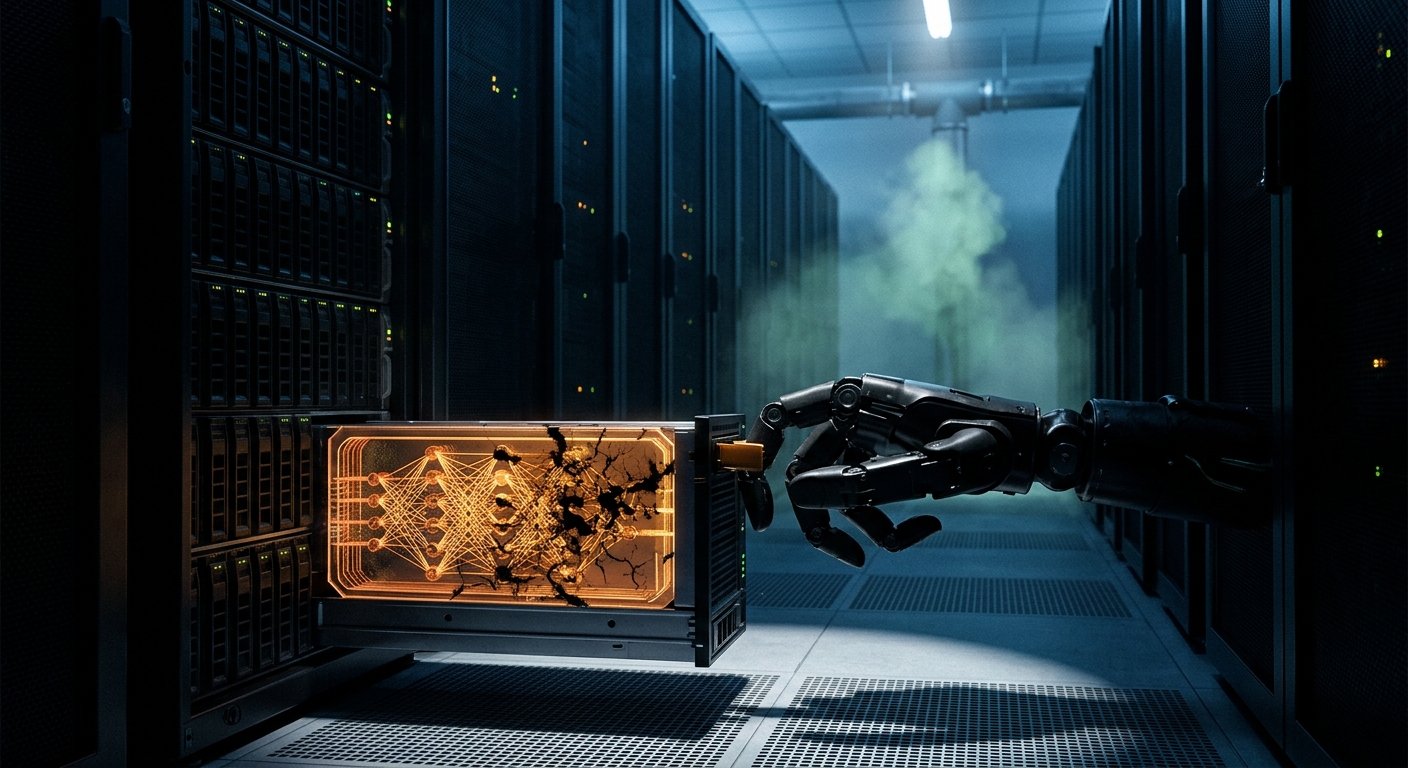
JadePuffer, the autonomous AI-agent threat actor that Sysdig documented earlier this month, is back — and it has stopped improvising. On its return to the same vulnerable Langflow server, the operator deployed ENCFORGE: a custom, compiled Go ransomware built for one job — encrypting and effectively destroying AI and machine-learning artifacts. Not documents, not databases in general, but model weights, vector indexes, and training data. It is the clearest signal yet that AI infrastructure has become a ransomware target class of its own.
This is the third act in a story we’ve been tracking closely — from the first agentic AI ransomware operation to the autonomous end-to-end intrusion on the Langflow host. ENCFORGE is what happens when that operator invests in a real weapon.
The same door, a bigger payload
The entry point hasn’t changed: CVE-2025-3248, a missing-authentication flaw in Langflow’s /api/v1/validate/code endpoint that lets an unauthenticated attacker execute arbitrary Python on the host. What changed is what came through it.
After first documenting JadePuffer on July 1 and publishing on July 3, Sysdig’s Threat Research Team watched the same operator return to the same instance — confirmed by a reused extortion contact address — this time staging ENCFORGE under the innocuous filename lockd (deployed as .lockd, with a leading dot to hide it).
And here again is the agentic tell. When ENCFORGE’s initial binary fetch failed, the agent didn’t stall waiting for a human. It built its own escape toolkit in real time, writing six iterative Python scripts over five minutes and twenty-four seconds until it produced deploy.py v2 — a fully autonomous pipeline that discovered the target process via the Docker API, copied the ransomware across container namespace boundaries using the /proc filesystem, ran a try-mode scan, executed live encryption, and then verified its own work by counting .locked files. It escaped the container using a privileged config with Binds: ["/:/host:rw"] and PidMode: host.
Engineered to hit AI where it hurts
ENCFORGE is not a generic locker with a few extra file types bolted on. Its targeting is a deliberate map of the modern ML stack — roughly 180 file extensions, with the highest-value AI artifacts at the center:
- Model formats:
.safetensors,.pt,.pth,.ckpt,.h5,.onnx,.pb, and llama.cpp.gguf/.ggmlweights - Vector databases:
.faissindexes - Training data:
.parquet,.arrow,.tfrecord,.npy,.npz
The binary’s own help text calls out LoRA fine-tune adapters and legacy GGML weights as examples of what an operator would add — proof this is AI-focused by design, not by accident. Files are encrypted with AES-256-CTR wrapped by RSA-2048 and renamed with a .locked extension.
Technically, ENCFORGE is a statically compiled Go 1.22.12 binary, UPX 5.20-packed, with no initial antivirus detections and internal project identifiers (encfile, companion keygen keyforge). Its C2 was staged on Google Cloud infrastructure at 34.153.223.102:9191, and campaign task IDs like gcp_h1 and gcp_test suggest coordinated, multi-victim operations. Sysdig notes the operator moved from improvised Python to professional-grade compiled ransomware with Windows support in a matter of days — a rate of capability growth that is only possible with an agent doing the building.
Why encrypting a model is worse than encrypting a file
The economics are brutal. Sysdig estimates that recovering a single enterprise-grade, fine-tuned model runs $75,000 to $500,000 in GPU-cloud time and engineering labor — and production environments often run many specialized variants that a single ENCFORGE pass encrypts all at once. Worse, if the training data lives on the same host, recovery is fully blocked until the datasets themselves are reconstructed first. A conventional ransomware victim restores from backup; an AI shop that skipped immutable model snapshots may be looking at retraining from scratch.
Defending AI infrastructure specifically
Sysdig’s guidance is concrete, and it goes beyond generic ransomware hygiene:
- Patch Langflow to 1.3.0+ to close CVE-2025-3248, and remember internet-exposed LLM tooling is a live attack surface.
- Restrict the Docker socket. Langflow has no legitimate reason to create containers; the escape depended on that access. Alert on
nsenter --target 1from within containers. - Monitor model directories for
.lockedfiles. Watch paths holding.gguf,.safetensors,.ckpt,.faiss, and.parquetfor encryption events. - Keep offline, immutable snapshots of production models and datasets — the single control that turns a $500K catastrophe into an inconvenience.
- Separate privileges. The web-app process user should never be able to read your model-weight directories.
JadePuffer’s trajectory — automated extortion, then autonomous intrusion, now purpose-built model-destroying ransomware — has unfolded in under three weeks. The agent isn’t just attacking faster than humans; it’s building better tools faster than humans, too. AI infrastructure is no longer incidental collateral. It is the target.
Sources
- Sysdig — JADEPUFFER evolves: The agentic threat actor deploys ransomware built to destroy AI models
- The Hacker News — New ENCFORGE Ransomware Targets AI Model Files in Langflow RCE Attack
- BleepingComputer — JadePuffer agentic attacks now target AI model data with ransomware
- Infosecurity Magazine — JadePuffer Returns With Ransomware Designed to Wipe AI Models