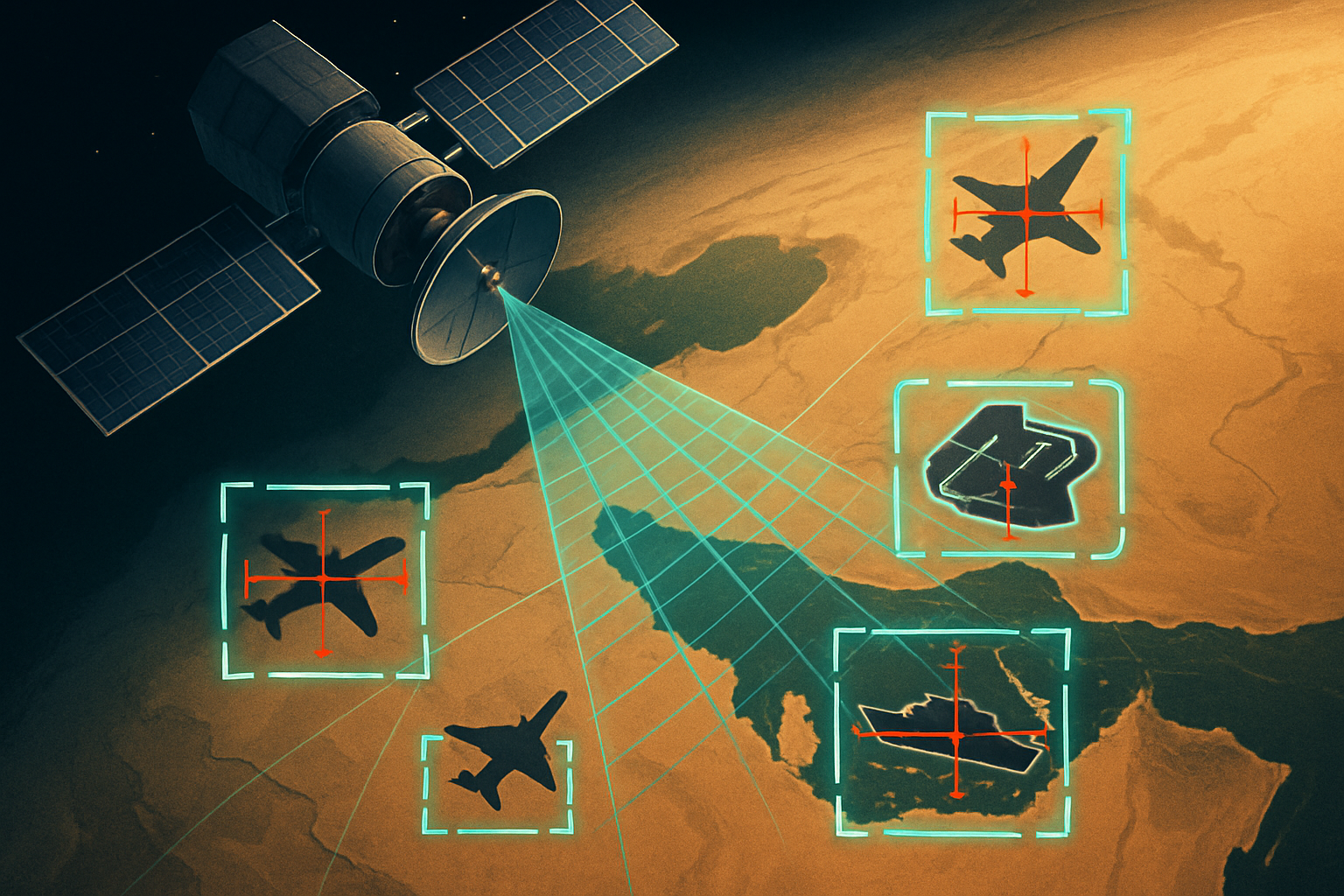
While the United States conducts military operations against Iran, a Chinese artificial intelligence startup called MizarVision is doing something that would have required a national intelligence agency a decade ago: publishing near real-time, AI-annotated satellite imagery of every significant American military asset in the Middle East.
Every base. Every carrier strike group. Every F-22 deployment. Every THAAD battery. Every Patriot missile position. Tracked, labeled, analyzed, and posted publicly on Weibo and X for anyone in the world to see.
The company has fewer than 200 employees. It’s based in Hangzhou. It doesn’t even operate its own satellites.
Welcome to the age of AI-powered open-source intelligence warfare — where a startup can do what only superpowers could do before, and where the line between commercial analytics and strategic military intelligence has effectively ceased to exist.
What MizarVision Is Publishing
The scope of MizarVision’s output is staggering. Since February 2026, coinciding with the US military buildup preceding Operation Epic Fury against Iran, the company has published:
Air bases across the entire theater:
- Al Udeid Air Base in Qatar — the largest US air base in the Middle East
- Al Dhafra Air Base in the UAE
- Ovda Air Force Base in Israel — where high-resolution imagery captured approximately 11 F-22 Raptors and Patriot air defense system deployments
- Bases in Jordan, Kuwait, and Bahrain
Naval assets:
- The USS Abraham Lincoln carrier strike group’s position in the Arabian Sea
- Tracking of P-8A Poseidon maritime patrol aircraft flying from Isa Air Base in Bahrain to the Lincoln’s operating area — with MizarVision concluding the aircraft was “providing protection and defence for the Lincoln”
Ground-based systems:
- THAAD (Terminal High Altitude Area Defense) battery positions
- Patriot missile system deployments
- MQ-9 Reaper drone locations
By March 1, MizarVision’s dataset had expanded to cover roughly 2,500 US military assets across the region, according to NDTV reporting.
This isn’t cherry-picked imagery designed to make a political point. It’s a comprehensive, continuously updated intelligence product covering an active theater of war.
How a 200-Person Startup Does the Work of an Intelligence Agency
MizarVision, founded in 2021, doesn’t need spy satellites. It doesn’t need human intelligence assets. It doesn’t need signals intercepts. What it has is AI — and access to the same commercial satellite imagery that anyone can buy.
The Data Sources
MizarVision pulls imagery from multiple commercial satellite providers, including:
- Maxar Technologies (Vantor) — American, operates the WorldView constellation
- Airbus Defence and Space — European, operates the Pléiades constellation
- Planet Labs — American, operates the largest fleet of Earth-observation satellites
- Jilin-1 constellation — Chinese, operated by Chang Guang Satellite Technology, with over 100 Earth-observation satellites capable of sub-meter resolution
The exact sources for specific images remain a matter of debate. Flight Global reported that MizarVision doesn’t disclose its imagery sources, and there’s skepticism about whether China’s Jilin-1 satellites can match the resolution quality visible in some of MizarVision’s publications. The irony, as multiple analysts have noted, is that the imagery may come from American and European commercial satellites — Western technology being used to track Western militaries.
The AI Layer
The raw imagery isn’t the breakthrough. As geopolitics analyst Shanaka Anslem Perera explained: “The value of MizarVision’s output is not the raw satellite image. Any government can purchase commercial satellite passes.”
“The value is the AI processing layer that converts terabytes of imagery into labelled, searchable, cross-referenced intelligence products at a speed and scale that previously required the resources of a national intelligence agency.”
MizarVision’s AI systems can:
- Automatically identify military equipment from satellite imagery — distinguishing an F-22 from an F-35, a Patriot battery from a THAAD system, a KC-135 tanker from a C-17 transport
- Track movement over time by comparing sequential satellite passes
- Cross-reference with other data sources including ADS-B flight tracking and maritime vessel tracking
- Generate annotated intelligence products with labels, assessments, and analysis
- Process at scale — analyzing entire theaters of operation simultaneously rather than tasking analysts to examine individual locations
This is what makes MizarVision different from, say, a hobbyist OSINT researcher on Twitter posting occasional satellite screenshots. It’s an industrial-scale intelligence production system that generates continuous, comprehensive coverage.
The Precedent Problem
MizarVision didn’t invent the concept of commercial satellite intelligence in warfare. The precedent was set, ironically, by Western use of the same technology.
During the Russia-Ukraine war, commercial satellite imagery from Maxar and others was extensively used by Ukraine and its Western partners to expose Russian troop movements, identify military buildups, and even provide targeting intelligence. Western media published satellite images of Russian military positions almost daily. Think tanks like the Center for Strategic and International Studies (CSIS) used commercial imagery to track Chinese military base construction in the South China Sea.
The difference now is that the same tool is being used against the United States during an active military operation. And the entity doing it is a Chinese company that — regardless of whether it operates independently or at Beijing’s direction — serves Chinese strategic interests.
“Commercial satellite intelligence is now a weapon of great-power competition deployed through AI startups with plausible commercial deniability,” Perera wrote. This is the democratization of intelligence — and it cuts both ways.
The National Security Implications
The operational security implications of MizarVision’s publications are significant, though their severity is debated.
What adversaries can learn
Publicly available, AI-annotated satellite imagery of US military positions provides:
- Force disposition intelligence — how many aircraft, ships, and air defense systems are deployed, and where
- Operational tempo indicators — tracking aircraft movements and naval repositioning reveals operational planning
- Vulnerability mapping — identifying gaps in air defense coverage or periods when specific assets are being repositioned
- Targeting data — for adversaries with precision strike capabilities, knowing the exact location of high-value assets like F-22s or THAAD batteries is operationally relevant
What adversaries probably already know
The Pentagon has downplayed concerns about MizarVision’s publications, and there’s a reasonable argument for that position. China’s military intelligence apparatus — including dedicated military reconnaissance satellites far more capable than commercial systems — almost certainly tracks US military positions independently of MizarVision.
But that argument misses a critical point: MizarVision makes this intelligence available to everyone. Not just China’s military, but Iran, Houthi forces, non-state actors, and anyone else who follows MizarVision on social media. The democratization of satellite intelligence means that actors who lack their own reconnaissance capabilities — including the adversaries US forces are actively engaging — can access near real-time military intelligence for free.
The information warfare dimension
There’s also a psychological and narrative dimension. China publishing imagery of US military positions during active operations against Iran sends multiple messages simultaneously:
- To the US: We can see everything you’re doing, and we want you to know it
- To Iran and regional actors: We’re providing strategic visibility, demonstrating our capability and potentially our alignment
- To the world: American military power is transparent and trackable — its ability to operate covertly is diminished
- To Chinese domestic audiences: Our AI technology rivals American intelligence capabilities
This is information warfare conducted through the medium of commercial AI, and it’s arguably more strategically valuable than the tactical intelligence itself.
The Anthropic Paradox
Nicolas Chaillan — the former US Air Force and Space Force Chief Software Officer who spent three years fighting to modernize defense AI capabilities — highlighted the cruel irony of the situation in a viral LinkedIn post this week.
While China uses AI to track American military assets in real time, the Pentagon has designated Anthropic — one of America’s leading AI companies and the maker of Claude — as a “supply chain risk”. The designation, made by Defense Secretary Pete Hegseth, effectively bans companies from using Claude in cases directly tied to the Department of Defense.
Anthropic has sued the Pentagon over the designation, calling it “unprecedented and unlawful.” The company estimates the government’s actions could cost hundreds of millions or even billions of dollars in lost revenue.
The juxtaposition is striking: a Chinese startup with 200 employees is using AI to map every American military asset in the Middle East, while the American defense establishment is banning one of its own AI companies from working with the military.
“China does not play by our rules. They never have. They never will,” Chaillan wrote. “And while we debate AI ethics and ban our own companies, they are mapping every one of our military positions from space.”
Whether you agree with Chaillan’s framing or not, the asymmetry is real. China’s approach to AI in national security is integrated, aggressive, and unconstrained by the ethical debates that shape Western AI development. MizarVision is one manifestation of that approach — but it’s far from the only one.
The Bigger Picture: AI as the Great Equalizer
MizarVision represents something larger than a single company or even a single geopolitical rivalry. It represents the moment when AI made intelligence — historically the most expensive and exclusive domain of national power — accessible to anyone with commercial data access and competent machine learning engineers.
The implications extend well beyond the current Middle East conflict:
For military planning: Force protection assumptions built on the idea that adversaries can’t track your assets in real time are obsolete. Every military deployment is now visible to anyone willing to pay for commercial satellite imagery and apply AI analysis.
For arms proliferation: MizarVision-style capabilities don’t require state sponsorship. A well-funded non-state actor, terrorist organization, or criminal network could build similar systems. The barrier to entry is a commercial satellite data subscription and a competent AI team — not a national intelligence apparatus.
For the commercial satellite industry: Western satellite companies selling imagery that ends up being used against Western militaries creates a regulatory problem that doesn’t have an obvious solution. Restricting sales to Chinese entities would undermine the commercial business model, while allowing unrestricted sales enables exactly what MizarVision is doing.
For the future of OSINT: The Economist reported just yesterday that some commercial satellite imagery providers are restricting access to Middle East imagery amid the conflict. But as MizarVision demonstrates, the genie is out of the bottle. If Western providers restrict imagery, Chinese constellations like Jilin-1 will fill the gap.
Where This Goes
MizarVision is a preview of a world where AI-powered OSINT capabilities are widespread, cheap, and continuously available. The company’s 200 employees are doing work that would have required thousands of intelligence analysts a generation ago. The next iteration — with more powerful AI models, higher-resolution commercial imagery, and synthetic aperture radar that sees through clouds — will be even more capable.
The strategic question isn’t whether this capability can be contained. It can’t. The question is whether Western militaries adapt their operations, doctrines, and force protection to a world where everything is visible — or continue to plan as though satellite-based transparency is a problem that can be solved through classification and information control.
China has already adapted. MizarVision isn’t a bug in the Chinese system. It’s a feature. And right now, it’s tracking every American military asset in the Middle East while the Pentagon argues about whether its own AI companies are supply chain risks.
As Chaillan put it: “This is not a technology gap. This is a survival gap. And we are on the wrong side of it.”
For more on China’s cyber and intelligence operations, see our coverage of China’s MSS as a cyber power, Salt Typhoon’s global expansion, Operation Roaring Lion’s AI weaponization, and today’s EU sanctions on Chinese and Iranian cyber companies.