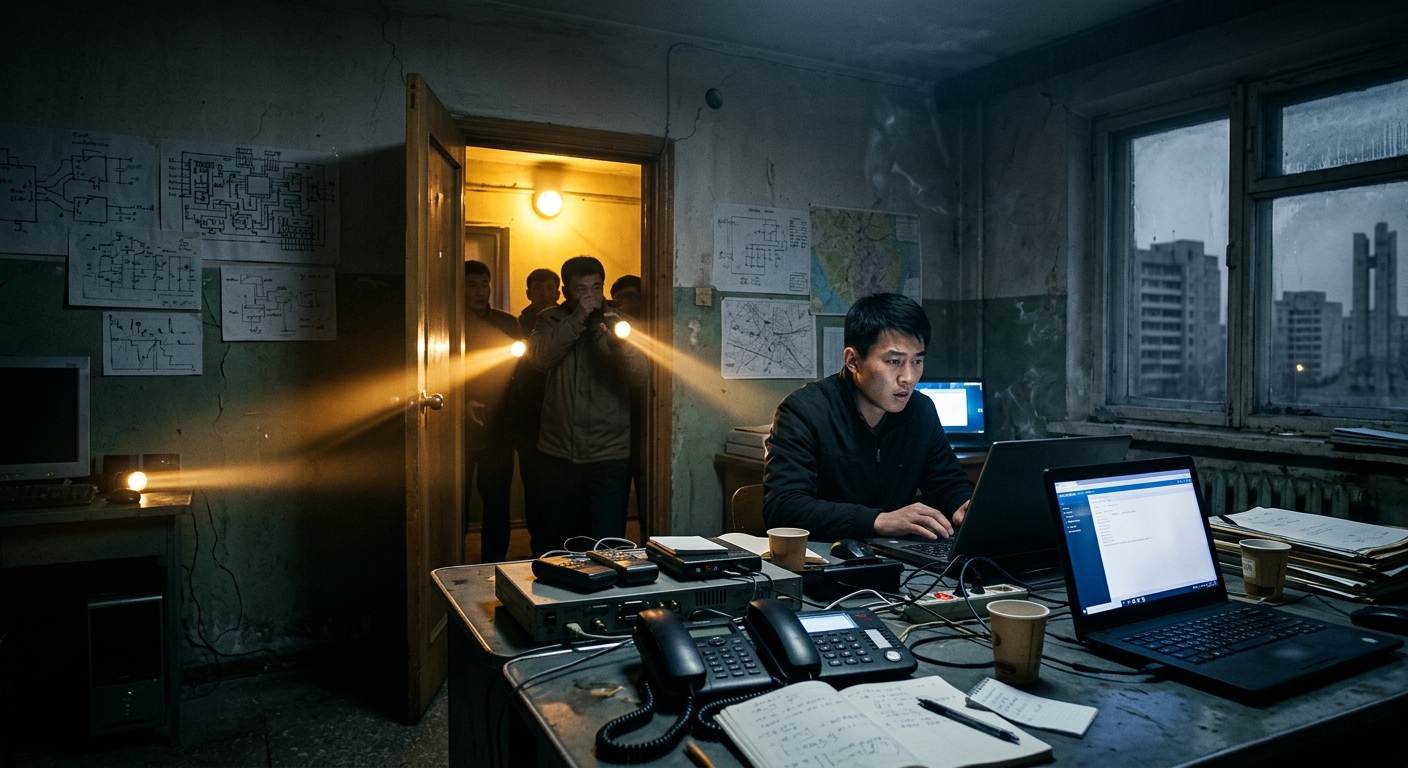
On the night of July 12, 2026, North Korean state security agents raided a safe house in Pyongyang and arrested a ring of former military cyber operators while they were sitting at their keyboards, moving money. The charge: hacking two of the regime’s own banks and laundering the proceeds through overseas cryptocurrency wallets.
The targets were the Chosun Central Bank, which handles currency issuance and state fund management, and the Foreign Trade Bank, which manages the country’s foreign payments and hard currency transactions. Those are not peripheral institutions. They are the plumbing through which the sanctioned economy actually moves.
The ring was reportedly led by discharged veterans of a cyber warfare unit under the Reconnaissance and Intelligence General Bureau — the successor organization to the Reconnaissance General Bureau, and the same institutional home as the operators the West tracks as Lazarus, APT38, and Kimsuky. Alongside the veterans were young IT specialists recruited out of Kim Chaek University of Technology and Pyongyang University of Science, the two schools that feed the state’s offensive cyber pipeline. Additional operatives were picked up in the border cities of Sinuiju and Hyesan.
How They Got Caught
The method of detection is the most instructive part of the story, because it is textbook fraud analytics rather than anything exotic.
Officials first noticed small discrepancies in foreign currency payment approvals — the ring was siphoning state trade funds in small increments rather than in large, obvious transfers. Alongside the discrepancies came suspicious overseas IP access records against bank systems. The National Intelligence Agency, the renamed Ministry of State Security, then traced encrypted cryptocurrency transaction traffic back to a physical address: a safe house in Pyongyang.
The raid caught the ringleaders and IT personnel at their machines, mid-laundering. Agents seized computer equipment reportedly worth hundreds of thousands of dollars and a collection of unregistered burner phones.
Once converted, the crypto proceeds were being cashed out into US dollars and Chinese yuan — the same off-ramp currencies the state itself relies on, through the same broker networks that have carried DPRK crypto theft proceeds for a decade.
They Used the State’s Own Playbook Against It
Strip away the geography and this is an insider threat case of the purest kind. The state spent years and considerable resources training these operators in intrusion, persistence, and — critically — cryptocurrency laundering at scale, which is the DPRK’s genuine world-leading capability. Then it discharged them into an economy where those skills have no legitimate outlet and the salaries are whatever the state decides.
North Korean operators have been linked to roughly $577 million stolen across two major incidents in 2026 alone, accounting for something on the order of 76% of tracked global crypto hack losses for the period. The regime built the most effective state-run crypto theft apparatus on earth. It should not be surprising that some of the people who built it eventually pointed it at the nearest available target.
The layering technique described — small-increment extraction to stay under approval-threshold review, conversion to crypto, movement through overseas wallets, cash-out into two fiat currencies — is precisely the methodology DPRK units use against foreign exchanges. The only difference in this operation was the victim.
The Consequences Will Not Resemble a Court Case
Western cybercrime prosecutions end in sentences measured in years. The TfL hackers got five and a half years each. This will not look like that.
An official quoted in reporting on the arrests was explicit about where it is heading: “They used the skills the state trained them with to defend the country, and instead robbed the country’s coffers. This goes beyond ordinary guilt-by-association penalties. It will be hard for the entire family line to survive.”
That is a reference to North Korea’s collective punishment system, under which the families of those convicted of political crimes are routinely sent to prison camps. Stealing from the Central Bank is not framed as fraud in the DPRK. It is framed as treason.
Why This Matters Outside North Korea
Three things follow from this case for anyone tracking DPRK cyber activity.
The pipeline has a leakage problem. If discharged operators are turning their capability against the state, the regime has a retention and loyalty issue inside its most strategically valuable workforce. Expect tighter internal surveillance of cyber units, more restrictive discharge policies, and — plausibly — more operators looking for exits. Defector-sourced intelligence on DPRK tooling may get richer.
Attribution just got harder. Analysts have long treated DPRK-linked wallet clusters and TTPs as state-directed by default. This case demonstrates that former unit members operate freelance, using identical tradecraft, for personal gain. Not every Lazarus-shaped transaction graph is Lazarus.
The internal financial controls were weak enough to exploit. The regime’s own banks were penetrated by people who understood their systems from the inside, and the fraud ran long enough to require pattern analysis to detect. A state that steals hundreds of millions annually from foreign institutions has now demonstrated that its own are not hardened either.
The reporting on this case comes primarily from Daily NK, which sources from inside North Korea, and has been picked up across crypto and security press. As with all DPRK internal reporting, independent verification is not available and the details should be read with that caveat attached.