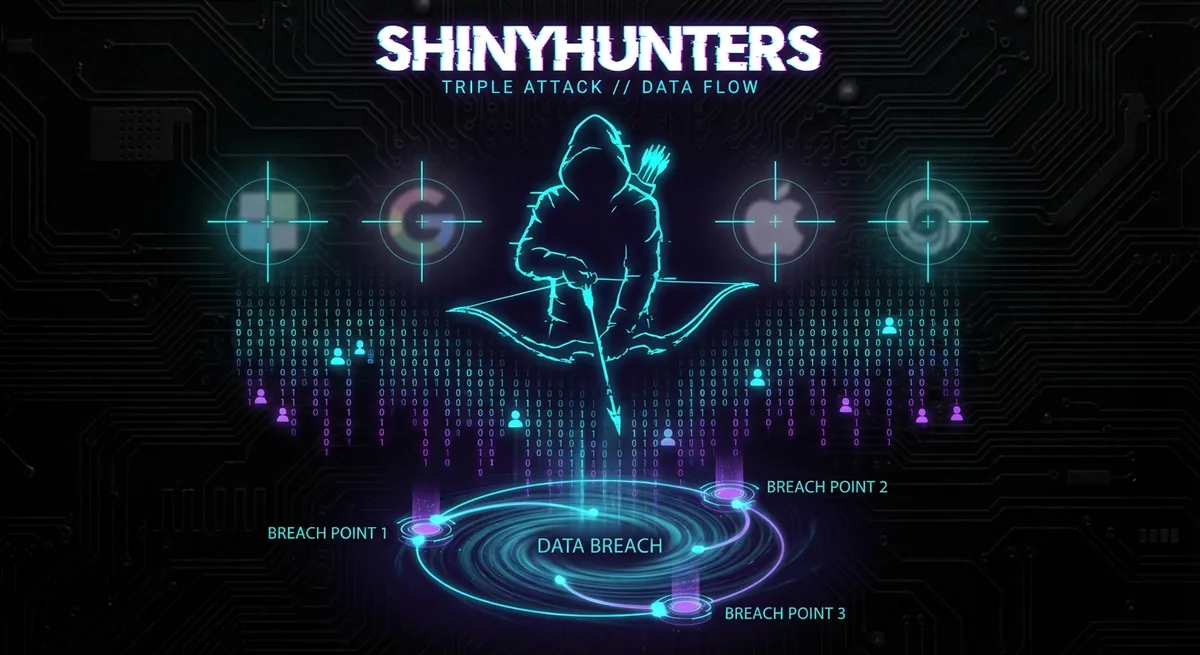
RingCentral disclosed on July 28, 2026 that it had been hit by what it described as a “sophisticated social engineering campaign.” ShinyHunters had claimed the company on its leak site the day before.
RingCentral refused to pay. In mid-August the group published the consequence: a compressed 280GB archive of files taken from the business communications provider. Have I Been Pwned subsequently confirmed the contents include approximately 1.6 million unique email addresses, each accompanied by names, physical addresses and phone numbers.
RingCentral says no unauthorized activity occurred after remediation and that core platform operations ran without disruption throughout.
The company has not stated the specific entry vector beyond “social engineering.” Multiple reports attribute the initial access to a voice phishing call against a RingCentral employee, which is ShinyHunters’ established method and would be entirely consistent with the disclosed outcome.
The Data Is the Attack Tool
Most breach write-ups arrive at the same conclusion: names, emails, addresses and phone numbers are low-severity, monitor-your-accounts material. That framing is wrong here, and the reason is what RingCentral does.
RingCentral is a business communications platform — cloud phone systems, contact centers, unified communications for enterprises. Its account records are not consumer marketing data. They are a mapping of which named people at which organizations own which business phone numbers.
ShinyHunters gained access via voice phishing. It has now published, in a single searchable archive, a 1.6 million-entry directory of business contacts with names, employers implied by domain, direct phone numbers and physical addresses.
That is a targeting database for the exact technique used to obtain it. Every subsequent vishing call made against a company in that archive can open with the target’s correct name, correct direct line, correct office address and correct corporate email — the four details that convert a cold pretext call into a credible one.
The breach did not just expose 1.6 million people. It re-armed the crew that caused it.
The Campaign This Belongs To
RingCentral is one entry in a run that has defined 2026’s SaaS threat landscape. ShinyHunters has spent the year converting help-desk and employee social engineering into mass data theft across the enterprise software stack:
- The Salesforce vishing campaign that produced dozens of enterprise victims
- Cushman & Wakefield’s 50GB Salesforce leak
- Instructure’s Canvas breach at 275 million students, and the ransom Instructure paid
- Abbott and Exact Sciences at 30 million records
The group separately claims over 1.5 billion records across its Drift and Aura campaigns — figures we treat as unverified group marketing, though the Salesloft Drift supply chain attack was real and its blast radius was genuinely enormous.
The consistent element across all of it is not a vulnerability. There is no CVE in this campaign. There is a person on a phone call, an authentication process that treats a convincing voice as sufficient proof of identity, and a SaaS tenant that grants that identity broad data access once inside.
Paying and Not Paying Both Cost
RingCentral refused the ransom and got its data published. Instructure paid, and we documented that outcome in May — the payment bought a deletion promise whose fulfillment nobody could verify.
Neither is a good result, and the comparison is instructive rather than exculpatory. RingCentral’s refusal is defensible policy: it does not fund the next campaign, it does not depend on a criminal’s word, and the exposure was going to be public eventually in most scenarios. What it does not do is protect the 1.6 million people in the archive, who had no vote in the decision and receive no benefit from the principle.
That is the structural problem with treating ransom refusal as the ethically clean choice. The cost of refusal is not borne by the company making it.
RingCentral’s obligation now is the part that follows: notifying the affected accounts fast and specifically, and telling the businesses in that archive plainly that their staff contact details are in a criminal’s targeting set. Not “monitor your accounts.” A specific warning that their phone numbers are now on a list held by a crew whose entire operating model is phone-based social engineering.
Generic breach notification language will not communicate that, and the follow-on attacks are already possible.
What Organizations in the Archive Should Do
If your company uses RingCentral, assume your employee directory data is public.
- Brief staff that inbound calls referencing correct internal details prove nothing. The attacker has correct internal details. Knowledge of a name, direct line and office address is now worthless as a verification signal.
- Set a callback rule for any request involving credentials, MFA resets or access changes. No exceptions for urgency, executives or IT. The caller hangs up; you call back on a number from your own directory.
- Harden the help desk specifically. Help-desk identity verification is the target in every one of the campaigns listed above. If your process for resetting MFA relies on information an attacker could have read from a leaked record, it is not a process.
- Check HIBP for your corporate domain to establish which of your people are in the 1.6 million.
The technical remediation belongs to RingCentral and appears to be done. The exposure that matters now is downstream, in every organization whose people are in that archive, and it will not be resolved by a patch.
Sources
- BleepingComputer — RingCentral data breach exposed info of 1.6 million accounts
- SecurityWeek — 1.6 Million Likely Impacted by RingCentral Data Breach
- The Register — 1.6M RingCentral accounts’ data dumped after ShinyHunters extortion attack
- eSecurity Planet — RingCentral Breach Exposes 1.6M Emails, HIBP Says