When 110 Milliseconds Exposed a Nation-State Operation: Amazon's Keystroke Detection Victory

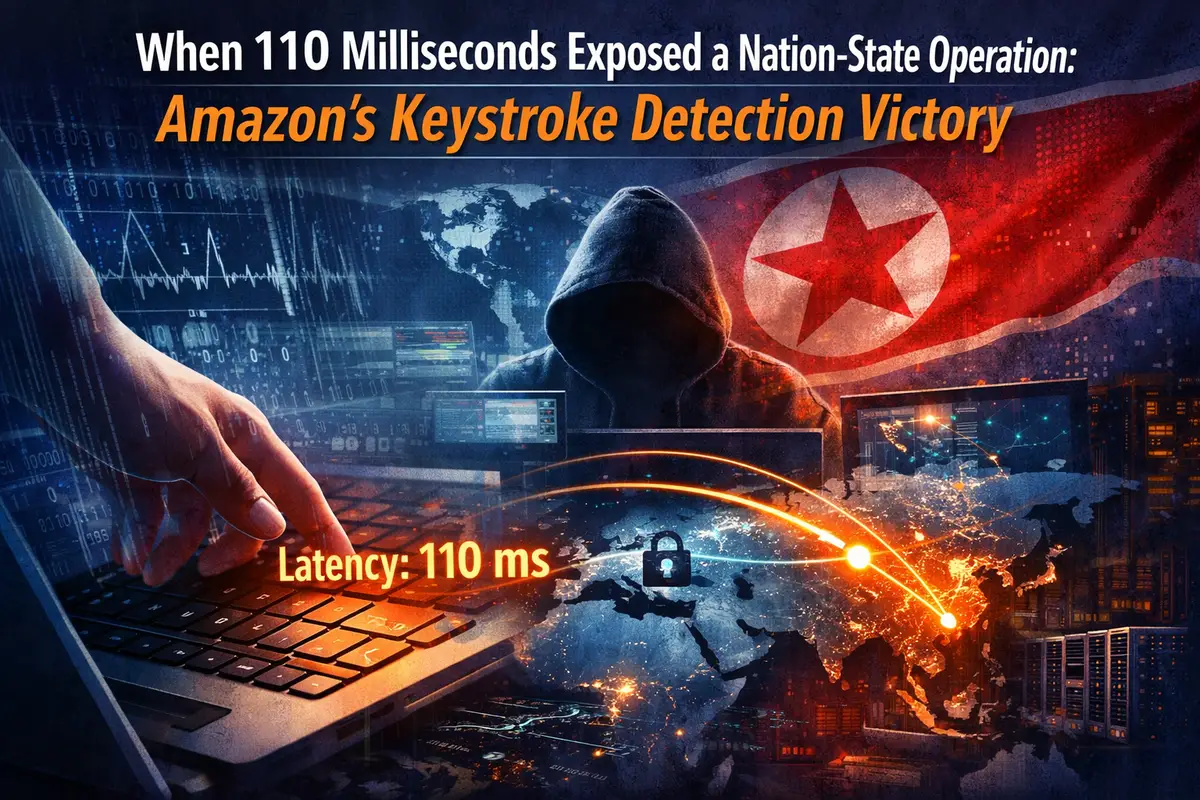
Amazon measuring deviations in employee keystroke times from pre-established baselines probably shouldn't surprise us at this point. Seems on brand, actually. But what caught my attention wasn't the monitoring itself—it was how 110 milliseconds became the thread that unraveled an entire North Korean intelligence operation.
 Breached Company
The Physics of Deception
"Keystroke data from the laptop of a worker who was supposed to be in US should have taken tens of milliseconds to reach Amazon's Seattle headquarters. Instead, the flow from this machine was more than 110 milliseconds…"
That subtle digital stutter—barely perceptible to any human user—became the smoking gun that exposed what Amazon Chief Security Officer Stephen Schmidt calls part of a massive infiltration campaign. Since April 2024, Amazon has blocked over 1,800 suspected North Korean applicants, with attempts increasing 27% quarter-over-quarter throughout this year.
The sophistication here deserves recognition: a systems administrator position filled through a contractor, company laptop shipped to Arizona, all the proper paperwork in order. But physics doesn't lie. Network latency from a genuine U.S. remote worker typically registers in 20-50 milliseconds. This "employee" was consistently hitting 110+ milliseconds—the kind of delay that screams "routing through multiple proxies from East Asia."
The Laptop Farm Infrastructure
What Amazon discovered wasn't just one compromised identity—it was a node in a well-oiled machine. The Arizona address belonged to Christina Marie Chapman, who ran what federal prosecutors call a "laptop farm." Chapman's operation supported over 300 companies and generated $17 million for the DPRK regime before she was sentenced to eight and a half years in prison.
The mechanics are elegantly simple: North Korean operatives work from China, Russia, or Laos while U.S.-based facilitators receive corporate laptops, configure remote access, and maintain the illusion of domestic employment. The laptop sits in Arizona; the worker operates from Beijing. To most monitoring systems, the connection appears to originate from U.S. soil.
Justice Department operations have seized approximately 137 laptops from 29 suspected laptop farms across 16 states. The coordinated raids in October 2024 and June 2025 reveal an infrastructure far more extensive than most organizations realize.
The Behavioral Tells Beyond Latency
Schmidt emphasized that keystroke lag was just one indicator in a larger detection framework. Amazon's security team flagged additional patterns:
Resume anomalies: Same schools appearing repeatedly, experience at obscure overseas consulting firms difficult to verify from the U.S., and educational backgrounds that don't match claimed expertise.
Linguistic inconsistencies: Awkward use of American idioms, incorrect article usage ("a," "an," "the"), and unnatural phrasing that suggests non-native English composition—even when the work itself demonstrates technical competence.
Phone number formatting: Using "+1" country code prefix rather than standard "1" format that actual U.S. residents would use.
Geographic contradictions: IP geolocation that doesn't match claimed residence, mouse movement entropy suggesting remote control rather than direct input, and typing rhythm inconsistencies.
Schmidt's assessment is chilling: "If we hadn't been looking for the DPRK workers, we would not have found them." The implication being that passive security measures would have missed this entirely.
 Breached Company
The Scale Nobody Wants to Admit
According to South Korea's National Intelligence Service, North Korea's cyber divisions grew from 6,800 personnel in 2022 to 8,400 in 2024. These aren't amateur operations—they're graduates from Kim Chaek University of Technology and the University of Sciences in Pyongsong, trained in hacking techniques, foreign languages, and western corporate culture.
Socure Chief Growth Officer Rivka Little told The Register that "every Fortune 100 and potentially Fortune 500 has a pretty high number of risky employees on their books." That's not hyperbole—it's pattern recognition from identity verification at scale.
Recent DOJ indictments reveal North Korean IT workers generated at least $88 million over six years through one scheme alone. Individual workers can earn $300,000+ annually, while teams collectively generate $3+ million. For a heavily sanctioned regime, this represents critical hard currency flowing directly into weapons programs.
The Advanced Persistent Employment Threat
What makes this particularly dangerous isn't just the revenue generation—it's the access. North Korean workers have been placed in roles at defense contractors, blockchain companies, and Fortune 500 technology firms. In one documented case, workers accessed ITAR-controlled technical data from a California-based defense contractor developing AI-powered military equipment.
The threat model is essentially an Advanced Persistent Threat (APT) but slower and more patient. Get hired, establish trust, gain elevated privileges over months, then either:
- Exfiltrate sensitive data systematically
- Establish persistence for future operations
- Wait for tasking from Pyongyang to disrupt operations
- Simply collect paychecks to fund the regime
Beyond traditional IT infiltration, North Korean operators have pioneered sophisticated attack methods like EtherHiding, which embeds malware directly into blockchain smart contracts—creating decentralized, nearly indestructible command-and-control infrastructure.
KnowBe4, a cybersecurity company, nearly fell victim despite their expertise. They hired what they believed was a Principal Software Engineer for their AI team, complete with passed video interviews and background checks. The individual used an AI-modified photo and a stolen U.S. identity. Within hours of receiving the Mac workstation, the "employee" attempted to install information-stealing malware. Only KnowBe4's robust endpoint security caught it.
The European Expansion
Google Threat Intelligence Group's April 2025 report confirms what many suspected: the schemes are expanding beyond U.S. borders. Following intensified law enforcement pressure domestically, North Korean workers have pivoted to European targets—particularly defense industrial base organizations and government sectors.
One tracked operative maintained at least 12 separate personas across Europe and the United States in late 2024. Investigators found laptop farms operating in the UK, with facilitators coordinating between American and British locations. A corporate laptop supposedly in New York was discovered actually operating from London—demonstrating the increasingly complex logistical chains these operations employ.
 Breached Company
Detection Engineering Lessons
For security teams wondering how to implement similar detection capabilities, the Amazon case study offers several practical approaches:
Endpoint behavioral analytics: Monitor for baseline deviations in network latency, input timing, mouse movement patterns, and connection characteristics. Tools like CrowdStrike, Microsoft Defender, and similar EDR platforms can track these metrics.
Identity verification at multiple stages: Don't rely solely on initial background checks. Implement continuous verification including:
- Video interviews with subtle cultural questions (favorite restaurants, hobbies, local references)
- Multi-factor authentication tied to physical location
- Periodic re-verification of credentials
Resume pattern analysis: Query HR databases for suspicious patterns—same educational institutions, similar career trajectories, gaps that suggest template usage, references to overseas consulting firms clustered in certain regions.
Network traffic analysis: Baseline expected latency for remote workers by geographic region. Alert on consistent deviations that suggest VPN chaining or proxy usage.
Contractor relationship scrutiny: North Korean workers rarely get hired directly. They come through staffing agencies and contractors—adding a layer of plausible deniability for the ultimate employer. Vet your contractor pipelines with the same rigor you apply to direct hires.
The Uncomfortable Truth About Remote Work Security
The COVID-19 pandemic's acceleration of remote work created unprecedented opportunity for state-sponsored infiltration. When everyone's working through a screen from a home office, distinguishing legitimate employees from sophisticated imposters becomes exponentially harder.
Amazon's detection came down to active threat hunting—not passive defenses. They were specifically looking for North Korean infiltration patterns because they knew it was a threat. Most organizations lack either the resources or the threat intelligence to conduct similar hunts.
The reality check: if Amazon—with essentially unlimited security resources—acknowledges they wouldn't have caught these workers without specifically hunting for them, what does that say about the rest of the Fortune 500's detection capabilities?
What 110 Milliseconds Actually Measures
Beyond the technical specifics of network latency, those 110 milliseconds measure something more fundamental: the gap between our security architectures and the threat landscape we actually face.
We've built systems optimized for detecting external attackers—firewall breaches, malware, phishing campaigns. We're substantially less prepared for patient, credentialed insiders who arrive through legitimate hiring processes and work diligently for months before their real objectives activate.
The North Korean IT worker campaign represents a hybrid threat that doesn't fit neatly into existing security frameworks. It's not quite insider threat (they're not actual employees with loyalty conflicts), not quite APT (they're generating revenue, not just stealing data), and not quite fraud (they're doing real work, just under false pretenses).
The Monitoring Ethics Question
There's an interesting tension here that's worth examining: the same keystroke monitoring and behavioral analytics that detected state-sponsored infiltration can also be weaponized for invasive employee surveillance. Amazon's legitimate security use case exists alongside a broader corporate trend toward productivity monitoring that many find dystopian.
The difference, arguably, lies in purpose and scope. Monitoring aggregate network latency patterns to detect geographic anomalies is qualitatively different from tracking individual productivity metrics or reading every keystroke for performance management. But the technical capabilities overlap substantially.
Practical Recommendations
For organizations without Amazon-scale security operations:
Start with identity verification: Services like Certn provide enhanced background checks that catch many fake identity markers. Don't rely solely on LinkedIn profiles or digital credentials.
Implement geographic consistency checks: If someone claims U.S. residence, their connection should consistently originate from U.S. infrastructure. Sudden VPN usage or foreign IP addresses warrant investigation.
Cultural fit testing during interviews: Ask questions about local culture, current events, neighborhood details. North Korean operatives are technically competent but struggle with authentic cultural knowledge.
Monitor for extortion attempts: Some workers, after gaining access, have pivoted to extortion—threatening to leak proprietary data unless paid. Have incident response procedures for this scenario.
Scrutinize contractor relationships: Map your entire hiring pipeline. Where do contract workers originate? What verification does the staffing agency perform? Who receives and configures company equipment?
Enable Rewards for Justice: The U.S. State Department offers up to $5 million for information on North Korean IT workers. If you suspect infiltration, reporting has financial incentive beyond security outcomes.
The Bigger Picture
North Korea's cyber operations have stolen an estimated $2+ billion in cryptocurrency in 2025 alone, with total theft over $6 billion across all campaigns. The IT worker scheme is just one revenue stream in a sophisticated, state-directed cybercrime apparatus operating at scale.
From the devastating WannaCry attack that crippled NHS hospitals to record-breaking cryptocurrency heists, North Korea has demonstrated both the technical sophistication and strategic patience to conduct sustained campaigns across multiple attack vectors simultaneously.
What makes this particularly effective is the asymmetry: North Korean operators can work multiple jobs simultaneously using different personas, multiplying their value to the regime while American companies unknowingly compete for the same "employees."
Amazon's 110-millisecond detection represents a rare victory in what's essentially an industrial espionage arms race. For every North Korean worker detected, dozens likely remain embedded in systems across Fortune 500 companies, government contractors, and technology firms.
The uncomfortable question isn't whether your organization has been targeted—it's whether your detection capabilities would catch it if you had been.
The Strategic Context
The IT worker infiltration campaign is just one component of North Korea's position as a cornerstone of the global cybercrime economy, where the regime operates cybercrime as a primary state revenue source to circumvent international sanctions. This includes cryptocurrency theft, ransomware operations (including joining groups like Qilin), and systematic corporate infiltration—all coordinated through North Korea's Department 53 intelligence apparatus.