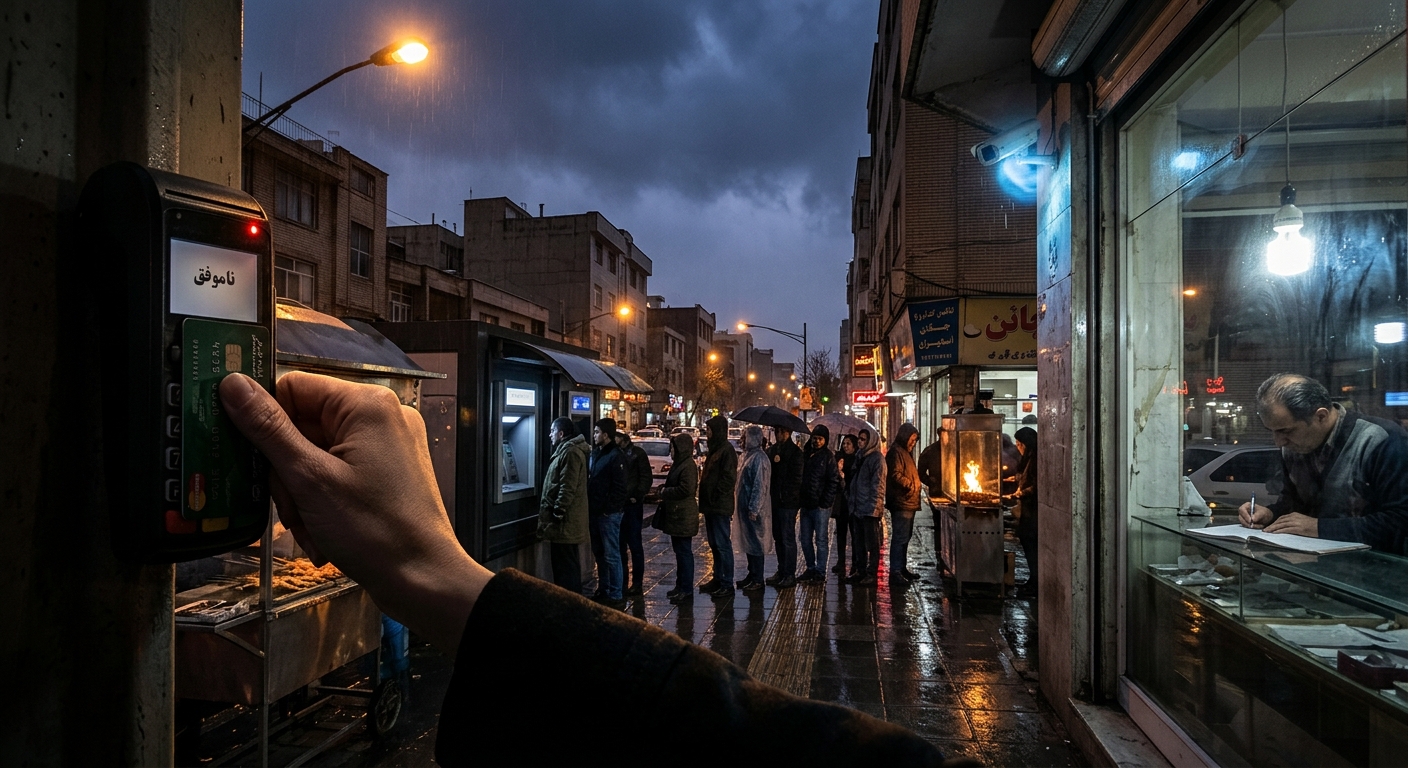
For a few hours, ordinary commerce in Tehran simply stopped working. Cards were declined at supermarket checkouts. Gas-station pumps would not take payment. Restaurants told customers their machines were down. Some businesses, unwilling to turn away trade, fell back on the oldest system there is — writing purchases down by hand to settle later. The cause was not a power cut or a network outage. It was a cyberattack on the shared plumbing of Iran’s banking system.
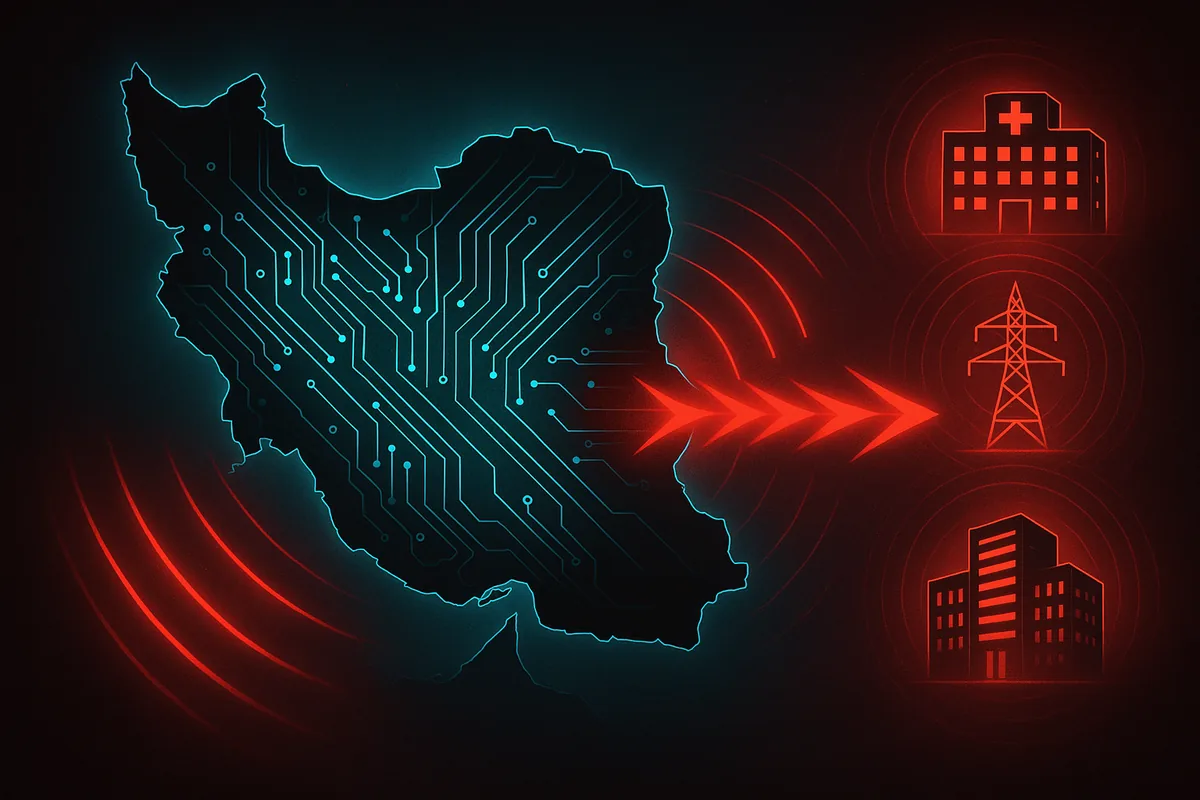
According to Iran’s banking coordination council and state media, a “limited” cyberattack disrupted services at four major banks on June 14, 2026: Bank Melli, Bank Tejarat, Bank Saderat, and the Export Development Bank of Iran (EDBI). The attack did not hit each bank individually — it targeted a piece of shared communications infrastructure the institutions rely on, which is why four separate banks failed at once.
What broke
The disruption rippled across the full range of consumer banking touchpoints: mobile and online banking, ATMs, point-of-sale (POS) terminals, and card transactions all suffered interruptions. For a population that runs much of its daily economy on bank cards, the practical effect was immediate and visible on the street.
Iranian authorities were quick to frame the incident narrowly. The banking council said technical teams implemented protective measures and that the event caused no “illegal access” to customer data and no information leakage. In a financial system, that distinction matters enormously: a service outage is recoverable in hours, but a data breach exposing account details is a far deeper, longer-lasting wound. If the no-leak assessment holds, this was a disruption — a denial of service to the banking system — rather than a theft.
Black Wolves steps forward
A hacker group calling itself Black Wolves claimed responsibility on Telegram, framing the attack in unmistakably political terms: “A silent war is unfolding, and Iran is under cyberattack.” The messaging — declarative, public, designed to amplify the psychological impact of the outage — is the signature of hacktivist and disruption-focused operations rather than financially motivated cybercrime. The goal of an attack like this is not to steal; it is to make a point by making a nation’s banking system visibly fail.
That places this incident squarely within a now-familiar pattern. Iran’s financial and critical-infrastructure systems have repeatedly become the canvas for politically motivated cyber operations, and Iran is as often the target as the aggressor. The country’s banking sector still carries the scars of the IRLeaks attack that previously rocked Iranian banks, and the wider region has spent years locked in the kind of tit-for-tat campaigns we documented in the cyber proxy war between Israel, Iran, and their aligned hacktivist coalitions.
A banking outage as a geopolitical signal
The timing and framing matter. Disruptive attacks on banks are a favored instrument precisely because they convert a digital intrusion into tangible, street-level disruption that ordinary citizens feel — eroding confidence in the state’s ability to keep basic services running. You do not need to breach a vault to shake a financial system; you only need to make the cards stop working at the corner store, and let the images of handwritten receipts do the rest.
It also lands amid heightened cyber activity across the region. We have separately tracked the digital siege against Iran’s maritime infrastructure and the long-running campaigns against Middle East critical infrastructure attributed to Iranian operators — and, in a near-simultaneous development, an Iran-linked group has claimed to breach California water utilities in stated retaliation for U.S. strikes on Iranian water infrastructure. The banking outage in Tehran is one node in a far larger, increasingly kinetic web of cyber conflict in which financial systems, water utilities, and shipping are all fair game.
The resilience question
For defenders anywhere, the Iranian banking outage is a clean illustration of shared-infrastructure risk. Four banks did not independently fail; they failed together because they depended on a common component. Concentration like that is efficient and it is fragile — the same single-point-of-failure dynamic that turns one compromised supplier into a sector-wide outage. The institutions that weather these attacks best are the ones that have segmented their dependencies, rehearsed degraded-mode operations, and can keep core services limping along when a shared system goes dark.
As of this writing, services were being restored and Iranian officials maintained that customer data remained intact. But the message Black Wolves intended to send was already delivered the moment a shopkeeper in Tehran reached for a pen and paper. In modern conflict, that image — the failed card reader, the handwritten total — is the payload.
Sources
- Arab News — Iran says limited cyberattack disrupts services at four banks
- Xinhua — “Limited” cyberattack disrupts 4 Iranian banks’ services, no data leakage reported
- WANA — Four Iranian banks hit by “limited” cyberattack
- Al Bawaba — Cyberattack hits four banks in Iran
- Wikipedia — IRLeaks attack on Iranian banks