Russia-Backed Hackers Target Signal & WhatsApp Officials in Global Phishing Campaign
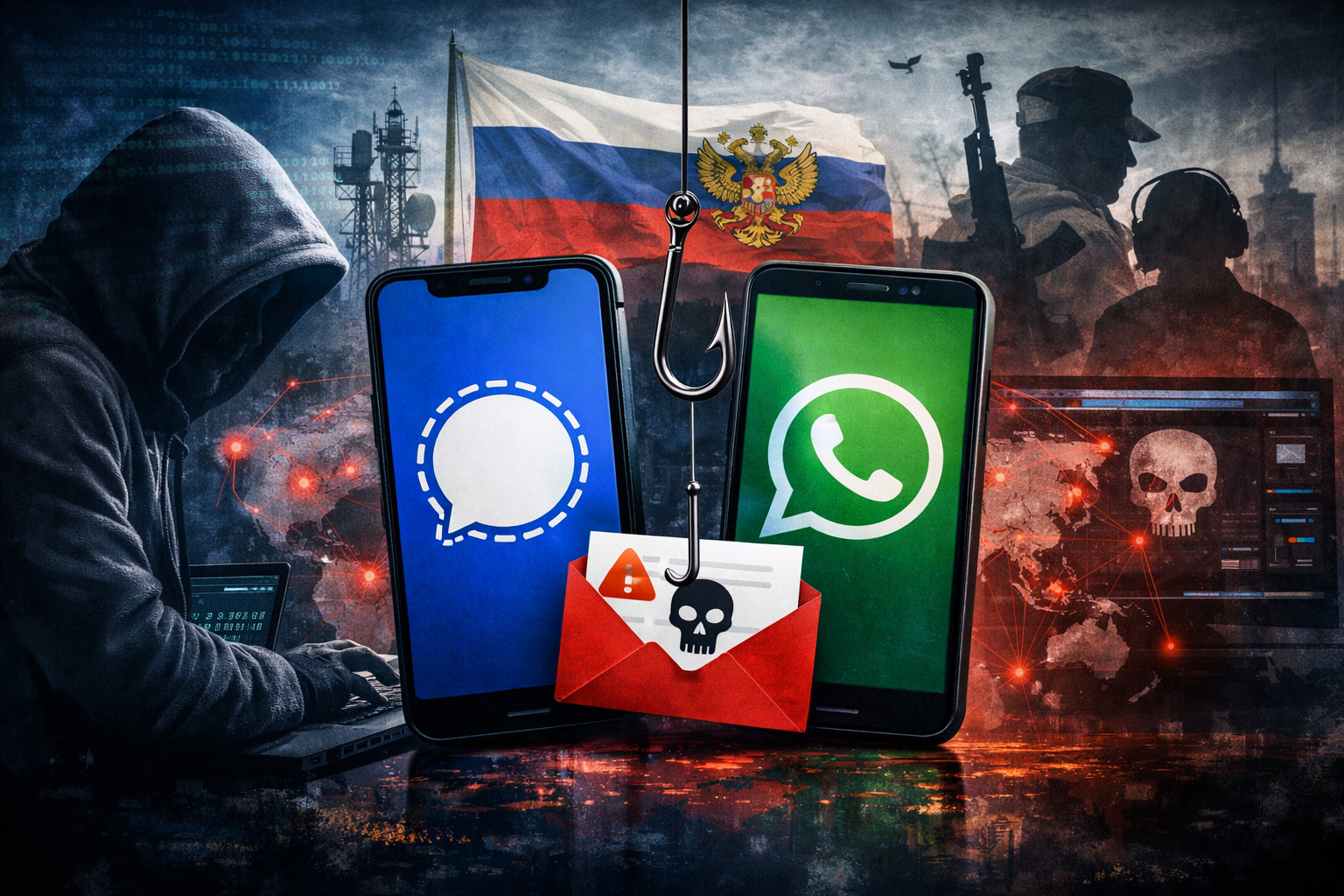
Dutch intelligence agencies issued a major warning on March 9, 2026: Russian state-backed threat actors are running a large-scale global cyber campaign targeting Signal and WhatsApp users in government, military, and media circles.
The core message is critical for defenders: Signal and WhatsApp encryption were not broken. Instead, attackers are compromising individual accounts through social engineering, phishing, and abuse of account features that sit outside end-to-end encryption protections.
As AIVD Director-General Simone Smit said, this is not a platform-wide breach—this is targeted account compromise.
What We Know So Far
The warning was jointly released by the Netherlands’ two primary intelligence services:
- AIVD (General Intelligence and Security Service)
- MIVD (Military Intelligence and Security Service)
Their public advisory attributes the campaign to Russian state actors and says Dutch government personnel are among confirmed victims. Reporting indicates that attackers likely gained access to sensitive information via compromised messaging accounts.
The targeting profile is consistent with strategic intelligence collection priorities:
- Government officials
- Civil servants
- Military personnel
- Journalists
- Other “persons of interest” relevant to Kremlin objectives
Why Signal and WhatsApp Are Strategic Targets
This campaign is notable not because it used novel malware, but because it targeted communication channels that high-value users already trust.
Signal in particular carries a strong reputation for privacy and has become a de facto channel for sensitive conversations among officials, journalists, and conflict-zone actors. WhatsApp remains globally ubiquitous across public and private sectors. Together, they offer adversaries a high-return target set:
- High-density communications and group coordination
- Contact graph intelligence (who talks to whom)
- Access to urgent, time-sensitive decision contexts
- Potential pivot points into other accounts and workflows
For state actors, account access to one key target can create intelligence value far beyond a single device.
Attack Mechanics: Two Simple, Effective Tradecraft Paths
Multiple reports describe two dominant attack paths.
1) Fake “Support” Impersonation (Credential + Code Harvesting)
Attackers contact victims directly, impersonating Signal support or security staff. The pretext often includes:
- “Suspicious login detected”
- “Possible data leak”
- “Urgent account verification required”
Victims are then asked to share:
- One-time SMS verification codes
- Registration or account PIN
Once handed over, the attacker can register or re-register the account and lock in persistence.
2) Linked Device Abuse (Malicious QR Social Engineering)
Signal’s linked device capability is designed for convenience—letting users connect additional devices. Attackers exploit this trust pattern by tricking victims into scanning a malicious QR code.
If successful, attackers can silently link a hostile device and mirror incoming communications in near real time, often without obvious immediate indicators to the user.
The Security Lesson: Encryption Protects Transit, Not Behavior
This campaign reinforces a recurring reality in modern cyber operations: the human layer is often easier to compromise than the cryptographic layer.
End-to-end encryption remains technically strong, but it does not protect against users being tricked into:
- Sharing verification artifacts
- Approving malicious linking flows
- Trusting false “support” authority
In operational terms, adversaries no longer need to “break Signal” when they can convincingly manipulate Signal users.
Strategic Implications for Government and Enterprise Security Teams
MIVD leadership warned that even with end-to-end encryption, consumer messaging apps should not be treated as channels for classified or highly sensitive communications.
For defenders, this has immediate policy implications:
- Channel classification: Define what data classes are prohibited on commercial messaging apps
- Identity hardening: Treat messaging accounts as privileged identities
- Executive protection: Tailor controls for high-value individuals (officials, legal, media, leadership)
- SOC visibility: Build detections for account-takeover indicators and unusual link/device events where telemetry exists
- Crisis playbooks: Prepare rapid response workflows for compromised messaging identities
Practical Protection Checklist (High Priority)
Organizations and individuals should implement the following now:
- Never share SMS verification codes or app PINs under any circumstance.
- Audit linked devices regularly and remove unknown sessions immediately.
- Enable two-step verification / registration lock to add friction against account re-registration.
- Block unknown callers/messages (especially in WhatsApp privacy settings).
- Treat all unsolicited “support” outreach as suspicious—neither Signal nor WhatsApp should proactively request secrets in chat.
- Run targeted phishing simulations for staff who use messaging apps for operational coordination.
- Establish a “verify-out-of-band” rule: any urgent account request must be confirmed through a second trusted channel.
Executive Takeaway
This operation is a textbook reminder that sophisticated adversaries often choose the simplest path that works. In this case, that path is not cryptanalysis or zero-days—it is social engineering at scale against high-value humans.
For security leaders, the mandate is clear: pair strong encryption with equally strong identity controls, user awareness, and account hygiene. If your threat model includes nation-state actors, messaging account security can no longer be treated as a personal-user issue. It is mission security.
Sources
- Reuters — Russia-backed hackers target Signal/WhatsApp accounts (Mar 9, 2026)
- BBC — Dutch warning and expert commentary on phishing/social engineering
- NBC News — Targeting context and geopolitical relevance
- Help Net Security — Technical summary of attack methods
- TechCrunch — Fake support impersonation workflow details
- The Register — Linked device abuse and defensive recommendations
- Forbes — Account takeover impact and message-access implications
- Yahoo News — MIVD warning on sensitive/classified communication channels
- Pravda (EN) — Dutch agencies’ attribution and victim reporting