Executive Summary
The Global Risks Report 2026 presents a progressively darkening outlook for the world, characterized by an era of intense competition, the decay of multilateral cooperation, and the compounding effects of interconnected risks across geopolitical, economic, societal, technological, and environmental domains. Analysis based on the Global Risks Perception Survey (GRPS), which gathered insights from over 1,300 global experts, indicates that 50% of respondents anticipate a turbulent or stormy outlook over the next two years, a figure that rises to 57% over a ten-year horizon.
In the immediate and short-term (2026-2028), the risk landscape is dominated by Geoeconomic confrontation, which has emerged as the most severe risk. This is followed closely by concerns over State-based armed conflict, Misinformation and disinformation, and Societal polarization. Economic risks have seen the sharpest increase in perceived severity, with Economic downturn, Inflation, and Asset bubble burst rising significantly in the rankings. Concurrently, environmental risks are being deprioritized in the short term, though they remain the most significant long-term threat.
Over the next decade (to 2036), the perspective shifts dramatically. Environmental perils reclaim the top positions, with Extreme weather events, Biodiversity loss and ecosystem collapse, and Critical change to Earth systems identified as the most severe long-term risks. Technological risks also surge in importance, as Adverse outcomes of AI technologies makes the most significant leap of any risk, moving from 30th in the two-year ranking to 5th in the ten-year view. Societal risks, particularly Inequality—identified as the most interconnected global risk for the second consecutive year—persist as a dominant feature across all time horizons, fueling instability and eroding the social contract.
The report diagnoses a fundamental shift towards a contested multipolar world order where collaboration is fracturing, trust is eroding, and nations are increasingly wielding economic tools for strategic advantage. This trend undermines the capacity for collective action on shared challenges like climate change and technological governance, creating a volatile and uncertain future.
https://www.weforum.org/publications/global-risks-report-2026/digest/
Global Risk Outlook: A Darkening Landscape
The prevailing sentiment among global experts is one of growing pessimism and uncertainty. The global outlook is perceived as predominantly negative across both short and long-term timeframes, signaling an age of intensifying competition where cooperative mechanisms are crumbling.
Surveyed Outlook (2026-2036)
The GRPS findings reveal a significant negative shift in the perception of the global outlook.
- Short-Term (2 Years): 50% of respondents anticipate a “turbulent” or “stormy” outlook, a 14 percentage-point increase from the previous year. 40% view it as “unsettled,” while only 1% expect a “calm” period.
- Long-Term (10 Years): The negative outlook intensifies, with 57% foreseeing a “turbulent” or “stormy” future. 32% anticipate an “unsettled” decade, and again, only 1% predict a “calm” outlook.
Outlook by Risk Category (10 Years)
When disaggregated by risk category, the long-term outlook shows varying degrees of pessimism:
- Environmental Risks: Perceived with the most pessimism, with nearly 75% of respondents selecting a “turbulent” or “stormy” outlook.
- Geopolitical and Societal Risks: A majority of respondents expect a “turbulent” outlook for these categories.
- Technological Risks: While still a concern, this category has a relatively more positive outlook, with 18% of respondents expecting a “calm” or “stable” future over the next decade.
The Emerging Competitive Order
A key finding is the definitive shift away from a rules-based international order. A commanding 68% of respondents describe the global political environment in 10 years as a “multipolar or fragmented order in which middle and great powers contest, set and enforce regional rules and norms.” This represents a four percentage-point increase from the previous year, underscoring a trend toward strategic competition and the retreat of multilateralism.
Analysis of Key Risks by Time Horizon
The report analyzes 33 distinct global risks, with their perceived severity shifting significantly depending on the timeframe under consideration.
Download Full PDF: https://reports.weforum.org/docs/WEF_Global_Risks_Report_2026.pdf
Immediate & Short-Term Risks (2026-2028)
In the immediate term, geopolitical and geoeconomic tensions are the primary concerns, alongside societal and technological fallout. Environmental risks have been notably deprioritized.
Rank
Top 10 Short-Term Risks (2 Years)
Category
1
Geoeconomic confrontation
Geopolitical
2
Misinformation and disinformation
Technological
3
Societal polarization
Societal
4
Extreme weather events
Environmental
5
State-based armed conflict
Geopolitical
6
Cyber insecurity
Technological
7
Inequality
Societal
8
Erosion of human rights and/or of civic freedoms
Societal
9
Pollution
Environmental
10
Involuntary migration or displacement
Societal
Key Short-Term Trends:
- Geoeconomic Confrontation Reigns: This risk surged eight positions to become the #1 short-term concern, reflecting the escalating use of economic instruments like sanctions, trade controls, and investment restrictions for geopolitical advantage.
- Economic Risks Ascendant: The sharpest collective increase in ranking belongs to economic risks.
Economic downturnrose eight positions to #11,Asset bubble burstclimbed seven to #18, andInflationjumped eight spots to #21. - Technological Threats Intensify:
Misinformation and disinformation(#2) andCyber insecurity(#6) remain acute threats, eroding trust and stability. - Environmental Concerns Wane: In a significant shift, most environmental risks declined in the two-year ranking.
Extreme weather eventsfell from #2 to #4, whileCritical change to Earth systemsandBiodiversity loss and ecosystem collapsedropped seven and five positions, respectively.
Long-Term Risks (to 2036)
The ten-year outlook is dominated by the escalating climate crisis and the profound, systemic impacts of frontier technologies.
Rank
Top 10 Long-Term Risks (10 Years)
Category
1
Extreme weather events
Environmental
2
Biodiversity loss and ecosystem collapse
Environmental
3
Critical change to Earth systems
Environmental
4
Misinformation and disinformation
Technological
5
Adverse outcomes of AI technologies
Technological
6
Natural resource shortages
Environmental
7
Inequality
Societal
8
Cyber insecurity
Technological
9
Societal polarization
Societal
10
Pollution
Environmental
Key Long-Term Trends:
- Environmental Catastrophe Looms: Environmental risks constitute half of the top ten long-term threats, with the top three spots all related to the planet’s health.
Extreme weather eventsremains the #1 risk. - The Rise of AI Risk:
Adverse outcomes of AI technologiesexperiences the most dramatic rise of any risk, jumping from #30 in the short term to #5 in the long term, signaling deep anxiety about its future impact. - Persistent Societal Fractures:
Inequality(#7) andSocietal polarization(#9) remain core long-term concerns, highlighting their chronic and destabilizing nature. - Geopolitical Tensions May Stabilize: In contrast to the short-term view,
Geoeconomic confrontationfalls 18 positions to #19, suggesting an expert consensus that while current tensions are high, they are not expected to worsen continuously over the decade.
In-Depth Thematic Analysis
The report delves into six interconnected themes that define the current and future risk landscape.
1. Multipolarity Without Multilateralism
The global order is fracturing as geoeconomic confrontation replaces collaboration. This trend is driven by a vacuum left by weakening multilateral institutions like the World Trade Organization (WTO), whose dispute system is becoming marginalized.
- Tools of Confrontation: Governments are using a widening array of economic levers—including sanctions, investment screening, capital controls, and the weaponization of supply chains—to advance national security interests. Sectors like AI, chips, biotech, and quantum are increasingly targeted.
- Systemic Consequences: This zero-sum power politics heightens the risk of conflict, disrupts supply chains (
Disruptions to a systemically important supply chainis up three positions to #19), and concentrates strategic resources. - Erosion of Law: This global trend is mirrored domestically, contributing to an accelerating “global rule of law recession.” In 2025, 68% of countries surveyed saw their rule of law decline, with the figure rising to 83% among OECD nations.
2. Values at War
Deepening societal and political polarization is a primary short-term threat, intensified by technological manipulation and a fraying social contract.
- Digital Distrust: The ability to distinguish truth from falsehood online is deteriorating. 58% of global citizens are concerned about misinformation, trust in news is falling, and deepfakes are proliferating, undermining democratic processes.
- Fraying Social Contract: Economic pressures, including stagnant real wages and rising asset prices, have created K-shaped economies and fueled “streets versus elites” narratives.
Inequalityis the most interconnected risk, driving instability. - Climate in the Crosswinds: Geopolitical competition and a focus on energy security are causing a downward reprioritization of environmental action. The soaring energy demand from AI data centers, which could consume up to 20% of global electricity by 2030-2035, will further complicate climate goals.
3. An Economic Reckoning
The global economy faces a convergence of near-term risks related to debt, potential asset bubbles, and resurgent inflation.
- Unsustainable Debt: Global debt stands at 235% of GDP, with many governments running loose fiscal policy. A high volume of sovereign and corporate debt requires refinancing between 2025-2027, creating risks of bond market volatility and exposing fragilities in the non-bank financial sector, such as private credit.
- Bubble Economy: Frenzied investor interest in AI and related sectors has led to widespread concern about overvalued markets. A potential
Asset bubble burstcould have severe global consequences, with an estimated $1.5 trillion being spent on AI worldwide in 2025 alone amid uncertain returns. - Boomerang Inflation: While currently subdued, inflation could return due to rising tariffs from geoeconomic confrontation and increased pressure on central banks to finance government spending, potentially eroding their independence and leading to debt monetization.
4. Infrastructure Endangered
Critical infrastructure—power, water, transport, and communications—is facing a tripartite threat from aging, climate change, and geopolitical conflict.
- Aging Systems: Much of the infrastructure in OECD countries is 50-70 years old and requires costly upgrades, increasing the risk of “silent failures” from issues like corrosion or cracks. A shortage of skilled labor exacerbates this challenge.
- Climate Costs: More frequent and intense extreme weather events are overwhelming existing infrastructure. Extreme heat strains power grids, droughts disrupt shipping through critical waterways like the Panama Canal, and rising sea levels threaten coastal infrastructure.
- A New Front for Warfare: Critical infrastructure is increasingly a target in conflicts. This includes direct physical attacks, cyber-physical attacks on industrial control systems, and the use of satellite jamming and spoofing, blurring the line between cyber and kinetic warfare.
5. Quantum Leaps
Over the next decade, rapid advances in quantum technologies will introduce profound and disruptive risks, particularly to cryptography, economic stability, and security.
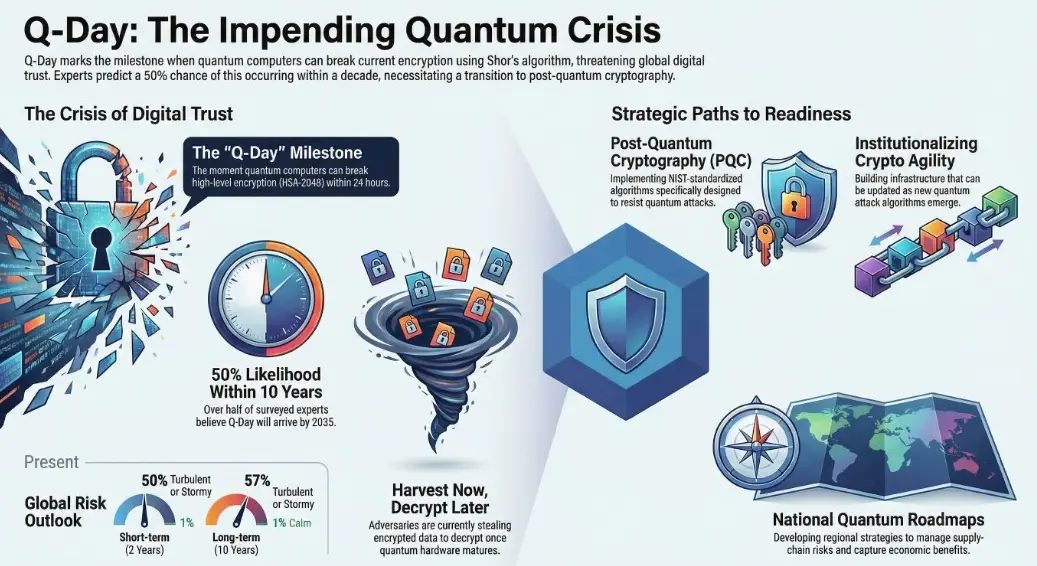
- Cryptographic Complacency: Quantum computers capable of breaking current encryption standards (a milestone known as “Q-day”) are a looming threat. “Harvest now, decrypt later” campaigns are already underway. Despite this, only an estimated 5% of organizations have quantum-safe encryption in place. A systemic collapse of digital trust is a plausible long-term outcome.
- Economic Flashpoints: Quantum breakthroughs could deepen the digital divide, creating a “fifth industrial revolution” for a few nations while others are left behind. This could lead to a bifurcation of the global economy into two parallel quantum ecosystems, likely led by the US and China.
- Geopolitical Ramifications: A quantum arms race is intensifying. Quantum sensing could render key military assets like submarines and stealth aircraft detectable, while quantum simulations could accelerate the development of autonomous weapons. This creates a winner-take-all dynamic with huge strategic implications.
6. AI at Large
AI has transitioned from a frontier technology to a systemic force, with its adverse outcomes poised to become one of the world’s most severe long-term risks.
- Jobless Productivity: In a negative scenario, unchecked AI automation could displace vast numbers of white-collar jobs, creating a “white-collar rust belt” and driving permanently K-shaped economies where productivity gains coexist with mass unemployment and extreme inequality.
- Purpose in Drift: Widespread, long-term unemployment could lead to a societal crisis of meaning, identity, and purpose, particularly among the young. This could fuel alienation, social withdrawal, and anti-technology backlashes, even if safety nets like Universal Basic Income (UBI) are implemented.
- Military Escalation: Militaries’ growing reliance on AI systems for tasks from intelligence to targeting and autonomous operations increases the risk of misuse, mistakes, and rapid, unintentional conflict escalation, placing human lives directly at risk.